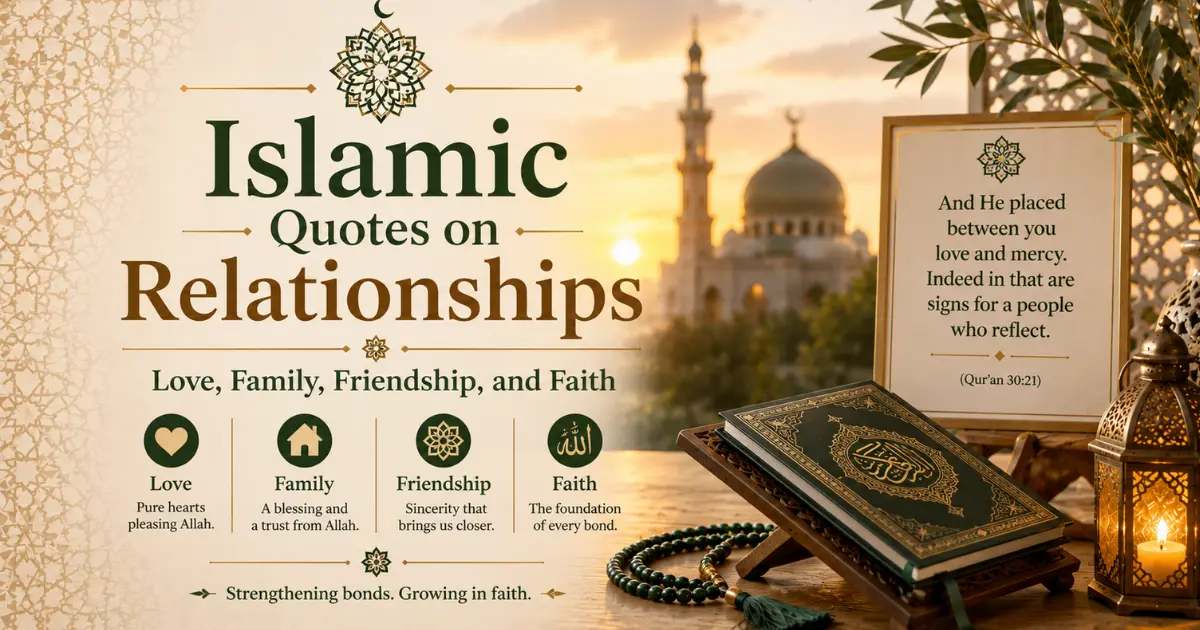
Every relationship in your life is really practice for something bigger. The patience you learn with a sibling, the loyalty you build with a friend, the love you grow into with a spouse — Islam treats all of it as connected, all of it as formation. None of these relationships exist in isolation. They shape your character, and your character shapes your relationship with Allah.
That’s the idea behind this post. Rather than just listing quotes, we wanted to map out how Islam actually views relationships as a whole — marriage, family, friendship, and ultimately, the relationship every other one is meant to strengthen: the one with Allah Himself.
At dpquotes.com, we’ve written in-depth about several of these relationships individually — marriage, parents, fathers — and we’ll link you to those deeper dives throughout. Think of this post as the starting point, the big picture. Wherever something resonates, follow the link and go deeper.
Why Islam Treats Relationships as a Whole System
It’s easy to think of faith as something private — prayer, fasting, personal belief. But Islam consistently frames relationships as one of the clearest places faith actually shows up. How you treat your spouse, how you speak to your parents, how you show up for a friend — none of it is separate from worship. It is worship, when done with the right intention.
That’s a genuinely freeing way to look at life. It means the ordinary, everyday moments — a patient conversation, a kept promise, a quiet act of loyalty — aren’t distractions from faith. They’re some of the clearest expressions of it.
Marriage and Love in Islam
Marriage holds a unique place in Islamic teaching — described not as a formality, but as a partnership built on mercy, patience, and mutual respect. The Quran describes spouses as a source of tranquility for each other, using language that’s tender rather than transactional: affection, mercy, closeness.
What makes Islamic marriage teachings distinct is the honesty behind them. There’s no promise of a flawless relationship. Instead, there’s a framework — treat each other with kindness, extend patience during hard seasons, and remember that how you treat your spouse reflects directly on your character before Allah.
If you want the full picture — verses on love and companionship, appreciation for husbands specifically, appreciation for wives specifically, and short captions for couples — we’ve covered that in depth in our Islamic Husband and Wife Quotes post.
Parents and Family
If there’s one relationship the Quran returns to again and again, it’s this one. Honoring parents is placed directly alongside the command to worship Allah alone — not as a suggestion, but as one of the clearest markers of a person’s faith.
What makes this teaching so meaningful is the reasoning behind it. Parents, especially mothers, carry a kind of sacrifice that’s mostly invisible until you’re old enough to look back and understand it. Islam responds to that by making gratitude toward parents an ongoing responsibility, not a one-time thank-you card.
For the full collection of verses and hadith on honoring both parents — plus guidance on caring for them as they age — check out our Islamic Quotes on Parents post. And if you’re looking for reflections specifically on fathers, our Islamic Quotes on Father post covers that ground in more depth.
Friendship in Islam
Friendship doesn’t get talked about as often as marriage or family in conversations about Islamic relationships, but the Quran and Sunnah have plenty to say about it — and it’s some of the most practical guidance available.
“A person is upon the religion of his close friend, so let one of you look at whom he befriends.”
— Jami at-Tirmidhi
This hadith is a quiet warning, and a useful one. Who you spend your time with shapes you more than most people realize, often without you noticing it happening in real time.
“The believers in their mutual kindness, compassion, and sympathy are just like one body. When one of the limbs suffers, the whole body responds to it with wakefulness and fever.”
— Sahih Al-Bukhari and Muslim
This is one of the most vivid descriptions of friendship and community in Islamic teaching. It doesn’t describe friendship as convenience — it describes it as shared experience, where someone else’s pain genuinely becomes something you carry too.
“The example of a good companion and a bad companion is that of a person carrying musk and a person blowing a blacksmith’s bellows. The one carrying musk will either give you some, or you will buy some from him, or you will get a good smell from him. As for the one blowing a blacksmith’s bellows, he will either burn your clothes, or you will get a bad smell from him.”
— Sahih Al-Bukhari
A memorable comparison that’s stuck around for centuries because it’s just true. The people around you leave a residue, one way or another — good or bad, whether you’re paying attention or not.
“Whoever relieves a believer’s hardship in this world, Allah will relieve his hardship on the Day of Judgment.”
— Sahih Muslim
Real friendship, in Islamic teaching, isn’t just about shared laughter — it’s about showing up for someone during their hardest moments, and doing so without expecting anything back.
A few reflections worth sitting with:
- A real friend tells you the truth, even when it’s easier to just agree.
- Loyalty isn’t tested during the easy years — it’s tested during the hard ones.
- The right friendships make you want to be better, not just feel comfortable.
- Some of the most valuable friendships are the quiet ones — no drama, just consistency.
Your Relationship With Allah
Every relationship covered so far is meant to point back to this one. Marriage, family, friendship — Islam treats all of them as training grounds for the qualities that matter most in a person’s relationship with Allah: patience, honesty, mercy, and consistency.
“And when My servants ask you concerning Me, indeed I am near. I respond to the invocation of the supplicant when he calls upon Me.”
— Surah Al-Baqarah 2:186
This verse describes something closer to a relationship than a rulebook — nearness, responsiveness, a two-way connection rather than a distant, one-directional obligation.
“So remember Me; I will remember you.”
— Surah Al-Baqarah 2:152
Short, but personal. It reads less like a command and more like an actual exchange between two parties who care about each other.
“Verily, in the remembrance of Allah do hearts find rest.”
— Surah Ar-Ra’d 13:28
Every other relationship in life offers some version of comfort, but this verse suggests something deeper — the kind of peace that doesn’t depend on anyone else showing up, staying consistent, or getting it right.
A few reflections on this relationship specifically:
- Every other relationship in life will ask something of you. This one only asks for sincerity.
- The quality of your other relationships often mirrors how consistent you are in this one.
- Unlike people, this relationship never requires you to compete for attention — you already have it.
- Whatever you’re carrying in every other relationship, this is the one that was never meant to be carried alone.
How These Relationships Connect to Each Other
It’s worth noticing the pattern across all of these — marriage, parents, friendship, and faith all ask for the same core qualities: patience, honesty, consistency, and mercy. None of them exist in a vacuum.
A person who struggles with patience in friendships will likely notice the same struggle in marriage. Someone who’s inconsistent in their relationship with Allah often finds that inconsistency showing up elsewhere too — in how they treat their parents, their spouse, their friends. It all connects, which is part of why Islam treats character-building in one relationship as beneficial to every other relationship in your life.
Practical Ways to Strengthen Every Relationship in Your Life
A few habits that apply across all four categories, not just one:
- Check your intention regularly. Are you showing up out of love and obligation, or out of routine and habit? The difference matters more than it seems.
- Practice patience in the small moments, not just the big ones — a repeated conversation with a parent, a minor disagreement with a spouse, a friend who’s going through something slow to resolve.
- Make dua for the people in your life, not just for yourself. It shifts how you see them, even on frustrating days.
- Be the friend, spouse, or child you’d want to have. It’s a simple standard, but it’s a genuinely useful one to return to.
- Remember that consistency in faith tends to show up everywhere else. Strengthening your connection to Allah rarely stays contained to just that one relationship.
FAQs About Islamic Quotes on Relationships
Islam consistently frames relationships — marriage, family, friendship — as extensions of worship, emphasizing patience, honesty, and mercy across all of them. Good character in one relationship is generally seen as reflecting a person’s broader connection to their faith.
Multiple hadith, including the well-known comparison of good and bad companionship to carrying musk versus blowing a blacksmith’s bellows, highlight how significantly friendships shape a person’s character, values, and even faith over time.
The Quran describes Allah as near and responsive, using language that reflects a genuine two-way relationship rather than a distant obligation — verses like Surah Al-Baqarah 2:186 and 2:152 emphasize closeness, remembrance, and mutual connection.
Full collections on those topics are available in our dedicated posts — see our Islamic Husband and Wife Quotes post for marriage, and our Islamic Quotes on Parents post for family-specific guidance.
Final Thoughts
Every relationship in your life is teaching you something, whether or not you notice it in the moment. The patience you build with your parents, the loyalty you offer a friend, the mercy you extend to a spouse — all of it circles back to the same core qualities Islam asks you to bring into your relationship with Allah. None of these connections exist separately. They’re all part of the same, ongoing practice of showing up with sincerity.
Want to go deeper into any of these relationships? Explore our full posts on marriage, parents, and fathers — and check back on dpquotes.com as we continue building out this collection.