
A quote of the day is one short, meaningful line picked each day to give you perspective, encouragement, or a useful lesson to carry through your day.
Today’s quote of the day with meaning is in the first section below. I’ll explain it in plain English, share its source, and suggest one small action to try. I check every quote against a book, speech, letter, interview, or other reliable record. If I can’t confirm who said it, I’ll say so clearly. The page updates daily, usually around 12:00 AM Eastern Time (ET).
Today’s Quote of the Day (With Meaning)
Here is what today’s quote means, why it still matters, and one small way to put it into practice.
Tuesday, October 27, 2026
“I think I have learned that the best way to lift one’s self up is to help someone else.”
— Booker T. Washington, The Story of My Life and Work (1900)
Attribution Note: Booker T. Washington wrote this line in The Story of My Life and Work, Volume I, Chapter XV, “Cuban Education and the Chicago Peace Jubilee Address.” The original wording includes “I think I have learned”—a phrase often omitted from the popular version. The attribution is documented in the 1900 text. Washington was an educator who led Tuskegee Normal and Industrial Institute.
What It Really Means
Helping someone else doesn’t have to come at the expense of your own progress. Sometimes, sharing what you know, offering encouragement, or helping someone through a difficult moment can give your own life greater purpose.
Washington presents this as a lesson he learned through experience, not a rule that applies to every situation. The takeaway is simple: your progress and someone else’s progress don’t have to compete.
Why It Matters Today
When you’re struggling, it’s natural to focus on your own problems. But you may still have something valuable to offer someone else—a useful skill, a little time, or a few words of encouragement.
You don’t need to have everything figured out to make a difference. Helping someone take their next step can remind you that your experience and abilities have value, too.
Your Action Step
Think of one person who could use your help today. Share something you’ve learned, offer practical support, or encourage them to keep going. Choose something you can genuinely do without neglecting your own responsibilities.
Reflection Question
Who helped you when you needed it, and how could you offer that same kind of support to someone else?
Editor’s Insight
In Up from Slavery, Washington also wrote that helping the weak strengthens the person who gives that help. His broader point was about character: the way we treat people with fewer advantages says something about who we are.
Helping others isn’t a substitute for working toward your own goals. It’s a reminder that success can mean more than personal achievement. You can work toward a better life for yourself while making the path a little easier for someone else.
Quick Guide: Find the Right Quote of the Day That Speaks to You
Jump straight to the kind of quote you need today:
- Today’s Quote of the Day: the featured quote, its meaning, and one action step
- Most Powerful Quote of the Day: words that stay with you
- Motivational Quote of the Day: lines for when you need a push
- Inspirational Quote of the Day: a fresh perspective on life
- Positive Quote of the Day: hope, kindness, and gratitude
- Short Quote of the Day: six lines you can read in seconds
- Student Quote of the Day: focus, effort, and curiosity for studying
- School Quote of the Day: why learning matters
- Work and Career Quote of the Day: purpose, time, and effort
- Success Quote of the Day: lessons on achieving your goals
- Business & Leadership Quote of the day: wisdom from great leaders
- Life Quote of the Day: Stoic wisdom for stress and worry
- Quote of the Day FAQs: meaning, sources, and how to use a quote
Most Powerful Quote of the Day: Words That Stay With You
A most powerful quote of the day is one that stays with you after you close the page. These five are about persistence, failure, living your own life, the first step, and hope. Each is traced to the moment it was said or written.
Motivational Quote of the Day: Keep Going When It Gets Hard
A motivational quote of the day should get you moving. These six come from books and speeches where the words were actually written or spoken.
Most Powerful Quotes of the Day About Courage, Failure, and Hope
1.
Jim Valvano on Never Giving Up
“Don’t give up. Don’t ever give up.”
— Jim Valvano
Verified Source: Speech at the 1993 ESPY Awards, where Valvano received the Arthur Ashe Courage and Humanitarian Award. He called it the motto of the V Foundation for Cancer Research.
Valvano, a college basketball coach, said this at the 1993 ESPY Awards, about two months before he died of cancer. He called it the motto of the cancer research foundation he announced in that speech. When you are tired of trying, remember that he said it with far more at stake than most of us will face. Pick one thing you were ready to quit this week and give it one more day
2.
Steve Jobs on Living Your Own Life
“Your time is limited, so don’t waste it living someone else’s life.”
— Steve Jobs
Verified Source: Stanford University commencement address, June 12, 2005.
Jobs said this to graduates just before warning them not to be trapped by other people’s thinking. Your time is the one thing you cannot get back, so where it goes should be your decision. Look at one commitment on your calendar this week that you agreed to only to please someone else, and decide whether to keep it..
3.
Michael Jordan on Failure and Success
“I’ve failed over and over and over again in my life. And that is why I succeed.”
— Michael Jordan
Verified Source: Spoken in Nike’s 1997 television commercial “Failure.”
Attribution Note: The words were written for the commercial and are not from an interview, so I credit them as what Jordan said in the ad.
Jordan is describing how success is built: not by avoiding misses, but by taking the next shot after a miss. Think of something you stopped trying because of one bad result, and decide what your next attempt looks like.
4.
Neil Armstrong on the First Step on the Moon
“That’s one small step for [a] man, one giant leap for mankind.”
— Neil Armstrong
Verified Source: Spoken from the lunar surface during the Apollo 11 mission, July 20, 1969.
Attribution Note: Listeners did not hear the “a.” Armstrong said he meant to say “for a man” and believed he had said it, and NASA has supported that reading. The bracket marks the disputed word.
Armstrong said this as he stepped onto the lunar surface, with hundreds of millions of people listening. The line works because it is plain: one small movement, and a result that mattered to everyone. Big goals are reached the same way, through steps that look small at the time. Choose the one step you have been putting off and take it today
5.
Helen Keller on Optimism and Achievement
“Optimism is the faith that leads to achievement.”
— Helen Keller
Verified Source: Optimism (1903), preserved by the American Foundation for the Blind.
Keller wrote this in her 1903 essay on optimism. She is saying hope is not just a mood. It is what gets you to start, and starting is what leads to results. Name one thing you have been waiting to feel hopeful about before you begin, and take the first step anyway.
Motivational Quote of the Day: Keep Going When It Gets Hard
A motivational quote of the day should get you moving. These six come from books and speeches where the words were actually written or spoken.
Motivational Quotes for Pushing Through a Hard Stretch
6.
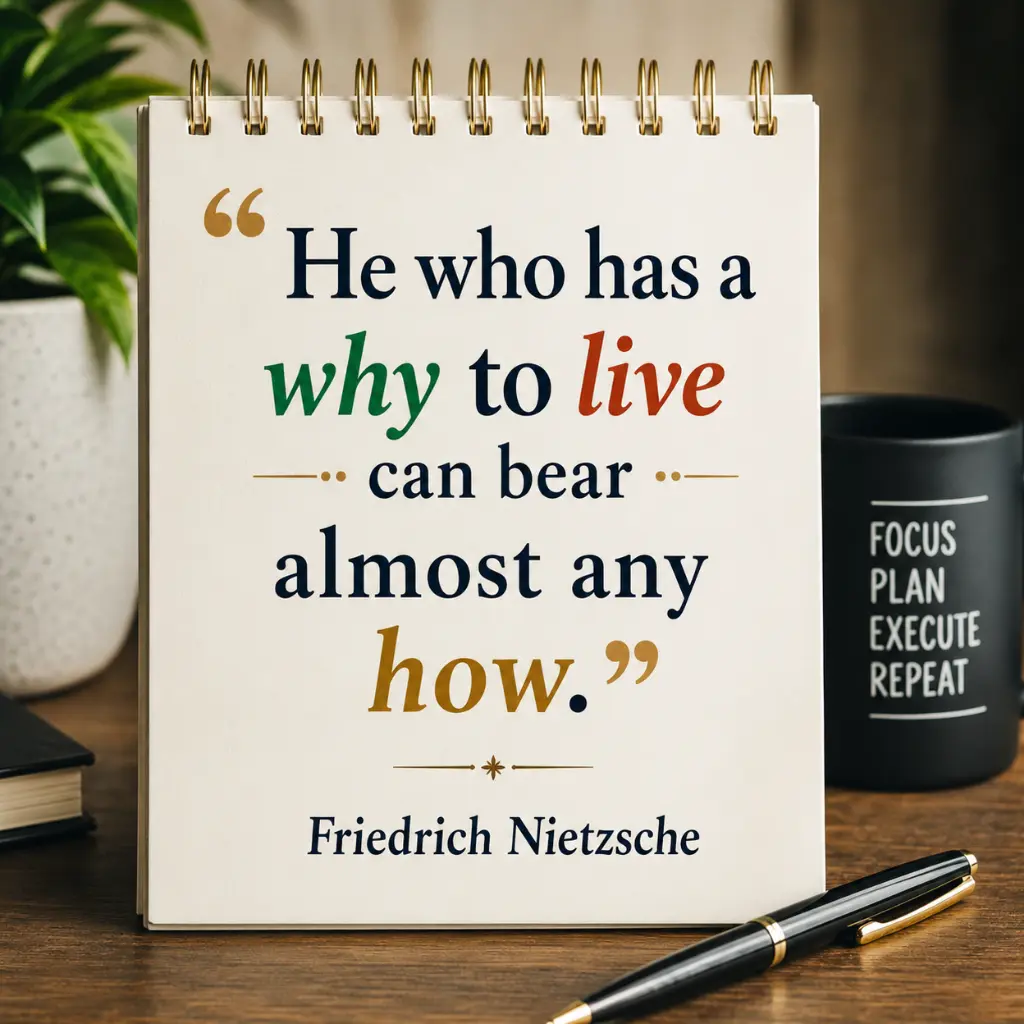
Friedrich Nietzsche on Having a Reason to Keep Going
7.
“He who has a why to live for can bear almost any how.”
― Friedrich Nietzsche
Verified Source: Twilight of the Idols (written 1888, published 1889), “Maxims and Arrows,” aphorism 12. A widely used English edition renders it, “If we have our own why in life, we shall get along with almost any how.” The shorter wording above is the popular form, and Viktor Frankl quoted a version of it in Man’s Search for Meaning. The aphorism continues with a sarcastic remark about the English.
When you know why you’re doing something, the hard parts cost less. Before your next rough stretch, write your reason in one sentence and make it concrete: a person, a skill, a date. Tape it somewhere you’ll see it on a bad day.
8.
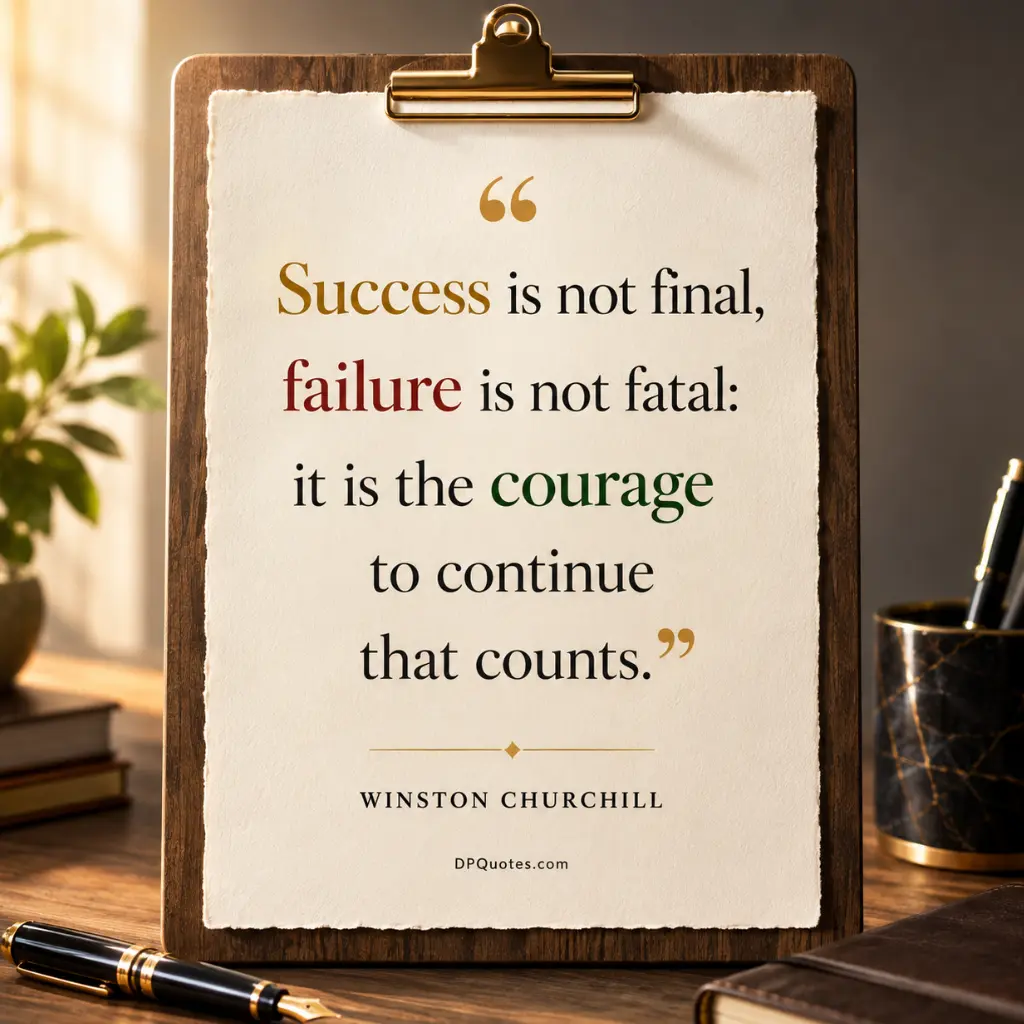
Honesty Note: This one isn’t verified. The International Churchill Society lists it among quotes falsely credited to him — it doesn’t show up anywhere in his speeches, writings, or the Churchill Archives at Cambridge. The earliest trace anyone’s found is a 1938 Budweiser ad, decades before it started circulating under Churchill’s name.
9.
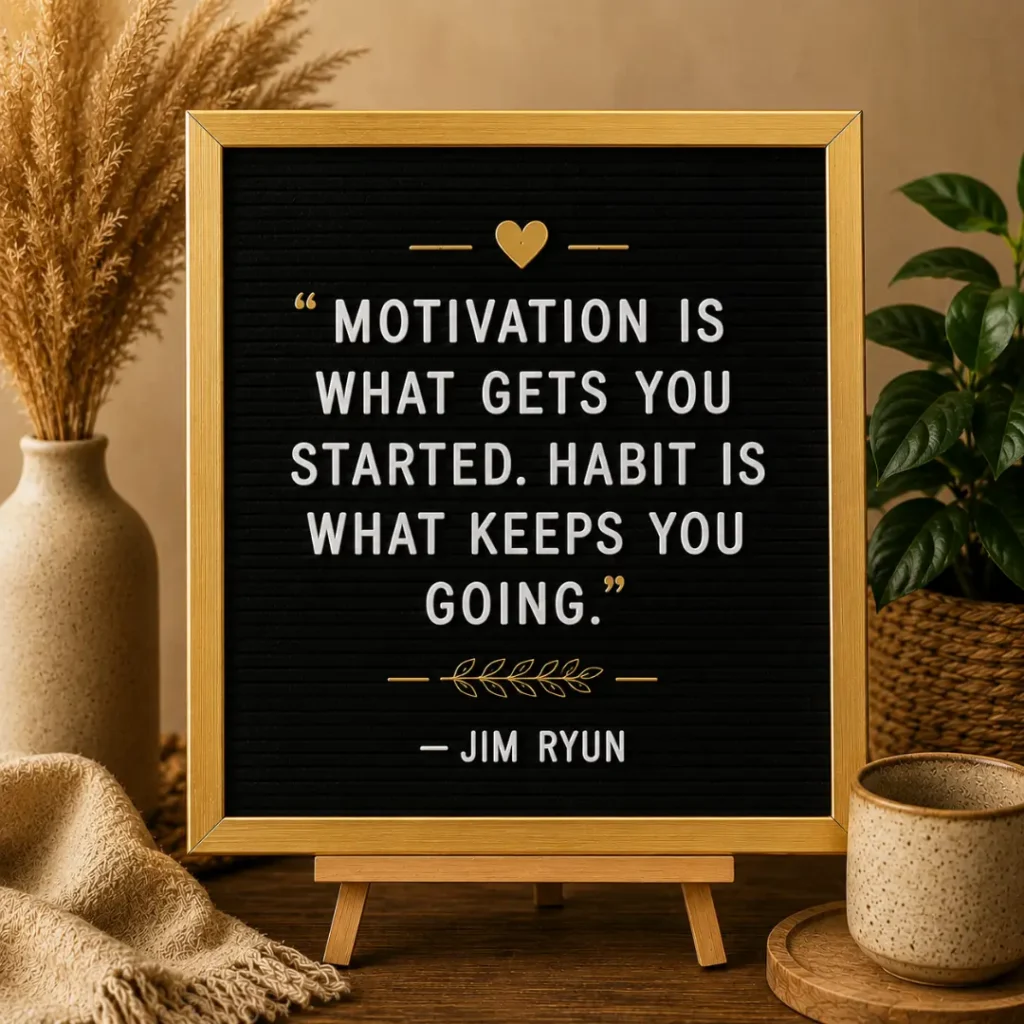
“Motivation is what gets you started. Habit is what keeps you going.” — Jim Ryun
Verified Source: Posted by Jim Ryun himself on his verified X (Twitter) account, @jimryun, December 28, 2014 — a rare case where you can point straight to the primary source in his own words.
10.
Theodore Roosevelt on Being the Person in the Arena
“The credit belongs to the man who is actually in the arena, whose face is marred by dust and sweat and blood.”
— Theodore Roosevelt
Verified Source: “Citizenship in a Republic,” speech delivered at the Sorbonne in Paris, April 23, 1910, often called “The Man in the Arena.”
Roosevelt hands the credit to people who try, fall short, and try again, and he has little patience for critics watching from the stands. Next time you’re hesitating over a draft, a launch, or a request for a raise, ask who is actually in the arena with you. Their opinion is the one worth weighing.
11.
Winston Churchill on Never Giving In
“Never give in—never, never, never, never, in nothing, great or small, large or petty—never give in except to convictions of honour and good sense.”
— Winston Churchill
Verified Source: Address to the boys of Harrow School, October 29, 1941. Churchill historian Richard Langworth notes that the popular “Never give up” is a misquotation; the word was “in.”
Attribution Note: You may have seen “Success is not final, failure is not fatal: it is the courage to continue that counts” credited to Churchill. The International Churchill Society found no trace of it in his writings, and the earliest close match Quote Investigator found is a 1938 Budweiser ad. It does not appear on this page as his.
Churchill ties persistence to conviction, and he leaves himself one exit: honour and good sense. So stopping can still fit his advice, if good sense is what tells you to stop. Before you walk away from something hard, check which one is talking, good sense or plain discomfort.
12.
Frederick Douglass on Progress and Struggle
“If there is no struggle there is no progress.”
— Frederick Douglass
Verified Source: “West India Emancipation,” speech delivered in Canandaigua, New York, August 3, 1857. It is also known as “The Significance of Emancipation in the West Indies.”
Douglass was speaking about the fight against slavery, and he says plainly that progress does not arrive without effort. Think of something you want and keep avoiding because it is uncomfortable, and decide what the first uncomfortable step is.
Motivational Quotes for Changing Course and Building Habits
12.
Viktor Frankl on Changing Yourself When You Cannot Change the Situation
“When we are no longer able to change a situation … we are challenged to change ourselves.”
— Viktor Frankl
Verified Source: Man’s Search for Meaning. In the book, a short aside sits where the ellipsis is: “just think of an incurable disease such as inoperable cancer.” The popular version leaves it out.
Frankl wrote this about suffering that could not be removed, and his point is that your response is still yours to change. Pick one situation you’ve been trying to control and decide what you can adjust in your own habits, plans, or reactions this week.
13.
Will Durant on Excellence as a Habit
“We are what we repeatedly do. Excellence, then, is not an act, but a habit.”
— Will Durant
Verified Source: The Story of Philosophy (1926), in the chapter on Aristotle, under his discussion of ethics and happiness.
Attribution Note: This line is often credited to Aristotle himself. Durant wrote it while summarizing Aristotle’s ethics, so the idea is Aristotle’s and the wording is Durant’s.
Durant is saying that character comes from repetition, not from one big effort. Choose an action you can repeat in ten minutes or less and hook it to something you already do, like your morning coffee.
For more on staying the course, see these never give up quotes and motivational quotes for success.
Inspirational Quote of the Day: A Fresh Perspective on Life
An inspirational quote of the day shifts how you see something familiar. These three are about beginnings, dreams, and where you choose to look.
Inspirational Quotes About Beginnings, Dreams, and Perspective
14.
Lao Tzu on the Journey of a Thousand Miles
“A journey of a thousand miles begins with a single step.”
— Lao Tzu (Laozi)
Verified Source: Tao Te Ching, chapter 64. This is the common English rendering. The Chinese phrase literally says the journey begins “beneath the foot,” meaning the ground right under you.
A big goal looks impossible when you stare at the whole distance. Define a first step small enough to finish in fifteen minutes, and do it before anything else today.
15.
Henry David Thoreau on Living the Life You Imagine
“If one advances confidently in the direction of his dreams, and endeavors to live the life which he has imagined, he will meet with a success unexpected in common hours.”
— Henry David Thoreau
Verified Source: Walden (1854), “Conclusion.” In the book it follows the words “I learned this, at least, by my experiment.” The popular short form, “Go confidently in the direction of your dreams,” is a paraphrase.
Thoreau argues that moving toward the life you’ve pictured brings results you couldn’t have planned. Describe that life in two sentences, then put an hour on your calendar this week that belongs to it.
16.
Oscar Wilde on Looking at the Stars
“We are all in the gutter, but some of us are looking at the stars.”
— Oscar Wilde
Verified Source: Lady Windermere’s Fan (1892), Act III. The line is spoken by the character Lord Darlington.
Hard circumstances don’t decide where you point your attention. Choose one thing to look toward this month, and keep a small reminder of it where you’ll see it every day.
More like these are in our inspirational quotes collection.
Positive Quote of the Day: Hope, Kindness, and Gratitude
A positive quote of the day lifts your mood without pretending things are easy. These four come from people who spoke and wrote about hope, kindness, and gratitude, often during hard times.
Positive Quotes About Hope, Kindness, and Gratitude
17.
Helen Keller on What Matters Most
“The best and most beautiful things in the world cannot be seen nor even touched, but just felt in the heart.”
— Helen Keller
Verified Source: Letter to Rev. Phillips Brooks, South Boston, June 8, 1891, printed in The Story of My Life. In the letter, Keller says her teacher, Anne Sullivan, explained this to her.
Attribution Note: The familiar wording, “cannot be seen or even touched. They must be felt with the heart,” is a later variant. Quote Investigator traces that form to a 1969 Scholastic publication, not to Keller.
Keller was ten when she wrote this to Phillips Brooks, passing on what her teacher had taught her. The things that matter most, like someone showing up when you didn’t ask, rarely make a good photo. Tell one person about something they did that you never thanked them for.
18.
Fred Rogers on Looking for the Helpers
“Look for the helpers. You will always find people who are helping.”
— Fred Rogers (Mister Rogers)
Verified Source: Rogers told this story many times, recalling his mother’s advice when he saw scary news as a boy. His wording varied slightly from telling to telling, and the earliest dated version I could confirm is from 1986.
When the news is bad, plenty of people are already helping, and you can choose to look for them. Notice one helper today and thank them. Better yet, be one.
19.
Martin Luther King Jr. on Light and Love
“Darkness cannot drive out darkness; only light can do that.”
— Martin Luther King Jr.
Verified Source: Strength to Love (1963), chapter 5, “Loving Your Enemies.”
Hitting back at hostility feeds it. The next time someone is rude to you, answer once with courtesy and see what changes.
For more uplifting reads, try our positive quotes, start your day with good morning quotes, or say a few positive affirmations.
Short Quote of the Day: 6 Lines Worth Remembering
A short quote of the day is easy to carry. These six are brief enough to remember by lunchtime, and each one is traced to a source.
Short Quotes of the Day With Meanings
- “The unexamined life is not worth living.” — Socrates, in Plato’s Apology, 38a. This is the common modern wording; Benjamin Jowett’s translation reads, “the life which is unexamined is not worth living.” Meaning: A life run on autopilot leaves out the questions that make it yours.
- “Well done is better than well said.” — Benjamin Franklin, Poor Richard’s Almanack (1737). Meaning: People trust results more than speeches, so do the work first and let it speak.
- “Imagination is more important than knowledge.” — Albert Einstein, interview in The Saturday Evening Post, October 26, 1929. Meaning: What you already know sets the starting point. Imagination decides how far you go from it.
- “The only thing we have to fear is fear itself.” — Franklin D. Roosevelt, First Inaugural Address, March 4, 1933. Meaning: Unchecked fear can freeze you before the real problem even arrives.
- “I learned that courage was not the absence of fear, but the triumph over it.” — Nelson Mandela, Long Walk to Freedom (1994). Meaning: Courage means acting while you are afraid.
- “You must do the thing you think you cannot do.” — Eleanor Roosevelt, You Learn by Living (1960), chapter 2. Meaning: Confidence comes after the attempt, so start before you feel ready
Want a fresh line every day? Browse the full library of daily quotes.
Student Quote of the Day: Focus, Effort, and Curiosity
A student quote of the day should help with the work in front of you. These three speak to effort, curiosity, and character, and they all trace to a published source. For quick lines to share, see our short quotes for students.
Student Quotes About Studying, Curiosity, and Effort
26.
Ralph Waldo Emerson on Enthusiasm
“Nothing great was ever achieved without enthusiasm.”
— Ralph Waldo Emerson
Verified Source: “Circles,” in Essays: First Series (1841).
Emerson is describing the energy that carries people through the dull middle of a big goal, like a semester or a hard course. Talent runs out and motivation comes and goes, but real interest in the subject is what gets the work finished. Find one thing in your hardest class that you are actually curious about and start there.
27.
Albert Einstein on Curiosity
“The important thing is not to stop questioning. Curiosity has its own reason for existence.”
— Albert Einstein
Verified Source: Interview with William Miller, LIFE magazine, May 2, 1955.
Attribution Note: Later books often print “existing” instead of “existence.” The wording above is the LIFE text.
Einstein said this in a conversation with a LIFE editor at his Princeton home. He is not talking about getting the right answer. He is saying the asking itself matters. When something in class doesn’t make sense, write the question down instead of skipping it, and bring it to your teacher or look it up tonight.
28.
Martin Luther King Jr. on the Goal of Education
“Intelligence plus character—that is the goal of true education.”
— Martin Luther King Jr.
Verified Source: “The Purpose of Education,” Maroon Tiger (Morehouse College), January–February 1947, as published by the King Institute at Stanford.
King wrote this as a student at Morehouse College. The sentence just before it says intelligence is not enough, because a sharp mind with no moral compass can do real harm. For a student, that means grades matter, but so does how you treat classmates and whether you do your own work honestly. Pick one habit today that shows both.
School Quote of the Day: Why Learning Matters
A school quote of the day suits a classroom, a morning announcement, or a parent’s note in a lunchbox. These three are about why school is worth showing up for. If you are choosing lines to read aloud at an event, our quotes for school assembly are written for that.
School Quotes About the Value of Education
29.
Malala Yousafzai on the Power of Education
“One child, one teacher, one book, and one pen can change the world.”
— Malala Yousafzai
Verified Source: Address to the United Nations Youth Assembly, New York, July 12, 2013.
Malala spoke these words at the United Nations at age 16, after she survived an attack for speaking up about girls’ schooling. The line is a reminder that a single book and a single teacher are enough to start something. Whatever you are studying right now, thank the person who taught it to you.
30.
Nelson Mandela on Education and Change
“Education is the most powerful weapon we can use to change the world.”
— Nelson Mandela
Verified Source: Speech at the launch of the Mindset Network, University of the Witwatersrand, Johannesburg, July 16, 2003 (Nelson Mandela Foundation transcript).
Attribution Note: You will often see “which you can use” in place of “we can use.” That wording is usually tied to a 1990 speech to schoolchildren in Boston. The 2003 transcript uses “we can use.”
Mandela said this while launching a project to improve learning in South African schools. A weapon is something that changes what you can do, and he is saying education does that for a person and for a country. Think of one thing you can do today that you couldn’t do a year ago because you learned it.
31.
Dr. Seuss on Reading and Learning
“The more that you read, the more things you will know. The more that you learn, the more places you’ll go.”
— Dr. Seuss (Theodor Seuss Geisel)
Verified Source: I Can Read with My Eyes Shut! (1978).
The two lines work as a pair: reading builds knowledge, and learning takes you to new places. It was written for beginning readers, but it holds for every age. Set a timer for ten minutes, read something you chose yourself, and notice what you remember afterward.
Work and Career Quote of the Day: Find Purpose in What You Do
These three are about meaningful work, how you spend your hours, and the effort behind talent: questions that come up in any job.
Quotes on Purpose, Time, and Effort
Theodore Roosevelt on Work Worth Doing
32.
“Far and away the best prize that life offers is the chance to work hard at work worth doing.”
— Theodore Roosevelt
Verified Source: Labor Day address to the New York State Agricultural Association, New York State Fair, Syracuse, September 7, 1903.
Roosevelt said this to a crowd at a state fair on Labor Day. His point is that the best thing life offers is not rest or reward but meaningful work done with real effort. Ask whether the work you do most days is work you would call worth doing, and if it is not, find one part of it you can make count.
33.
Benjamin Franklin on the Value of Time
“Remember that time is money.”
— Benjamin Franklin
Verified Source: “Advice to a Young Tradesman, Written by an Old One” (1748).
An hour spent always costs something, even when no bill arrives. Track one workday, find the hour that gave you the least back, and guard tomorrow’s version of it.
34.
Thomas Edison on Genius and Hard Work
“Genius is 1 percent inspiration and 99 percent perspiration.”
— Thomas Edison
Verified Source: The 1-to-99 version appears in print by 1901 (Idaho Daily Statesman, May 6, 1901) and in the 1910 biography Edison: His Life and Inventions.
Attribution Note: Early printings spell it “per cent.”; the wording above is modernized. Early reports also gave Edison’s ratio differently; an 1898 Ladies’ Home Journal piece put it at 2 to 98. The 1 to 99 form is the one that stuck.
Edison’s point is that talent gets you started and effort does the rest. Pick the part of your current project that needs steady work rather than a spark, and put an hour on it today.
Looking for more? See motivational quotes for work and teamwork quotes.
Success Quote of the Day: Lessons on Achieving Your Goals
A success quote of the day is most useful when it changes how you plan. These three cover determination, starting with the finish in mind, and what success really measures.
Success Quotes About Determination, Planning, and Perseverance
35.
Abraham Lincoln on Resolution to Succeed
“Always bear in mind that your own resolution to succeed, is more important than any other one thing.”
— Abraham Lincoln
Verified Source: Letter to Isham Reavis Jr., November 5, 1855, in reply to a young man asking about becoming a lawyer. The Papers of Abraham Lincoln hold the document.
Lincoln puts determination ahead of talent, connections, and circumstances. Write down the one result you most want this quarter, and the first thing you’ll do about it this week.
36.
Stephen Covey on Beginning With the End in Mind
“Begin with the end in mind.”
— Stephen R. Covey
Verified Source: The 7 Habits of Highly Effective People (1989), Habit 2.
Knowing what you want to end up with makes the small decisions easier. Write one sentence describing what “done” looks like for your biggest task this week.
37.
Booker T. Washington on What Success Really Measures
“Success is to be measured not so much by the position that one has reached in life as by the obstacles which he has overcome while trying to succeed.”
— Booker T. Washington
Verified Source: Up From Slavery (1901), chapter 2, “Boyhood Days.” In the book the sentence begins “I have learned that success is to be measured…”
Washington wrote this in Up From Slavery, looking back on a life that began in slavery. He is saying success is not a title or a position. It is measured by how much you overcame to reach it. Think of an obstacle you got past this year, and count it as part of your success.
More like these are in our success quotes collection.
Business and Leadership Quote of the Day: Wisdom From Great Leaders
A business and leadership quote of the day helps most when other people are counting on you. These three cover responsibility, preparation, and thinking long term.
Business and Leadership Quotes on Responsibility and Long-Term Thinking
38.
Harry S. Truman on Taking Responsibility
“The buck stops here.”
— Harry S. Truman
Verified Source: The sign on his desk while he was president (National Archives).
Attribution Note: Truman did not invent the phrase. The sign was made at the Federal Reformatory in El Reno, Oklahoma, and mailed to him in October 1945, after his friend Fred Canfil, a U.S. Marshal, saw a similar one there and asked for a copy.
The sign on the president’s desk made the point for him: when a decision is yours, the outcome is yours too, and blame cannot be passed down the line. Leading at any level works that way. Think of one decision you have been handing to someone else, and decide whether it is really yours to make.
39
Dwight D. Eisenhower on Planning
“Plans are worthless, but planning is everything.”
— Dwight D. Eisenhower (quoting an Army saying)
Verified Source: Remarks at the National Defense Executive Reserve Conference, Washington, D.C., November 14, 1957. Eisenhower introduced it as a saying he had heard long ago in the Army.
The plan will probably change. The thinking you did while building it is what prepares you for whatever replaces it. Before your next big project, spend thirty minutes listing what could go wrong and how you would respond.
40
Jeff Bezos on Thinking Long Term
“We believe that a fundamental measure of our success will be the shareholder value we create over the long term.”
— Jeff Bezos
Verified Source: Amazon’s 1997 Letter to Shareholders, in the section “It’s All About the Long Term.”
Bezos wrote this to shareholders when Amazon was a young company, telling them how it would be run. Judging a business by long-term value means turning down some quick wins. Whatever you are building, ask which of your habits will matter in a year, not just this week.
↑ Table of contents
Life Quote of the Day: Wisdom From the Stoics
A life quote of the day is worth keeping when it helps with ordinary stress. These three come from Stoic writers and speak to worry, habits of thought, and the stories we tell ourselves.
Life Quotes for Calmer, Clearer Thinking
37.
Marcus Aurelius on the Thoughts You Repeat
“Such as are thy habitual thoughts, such also will be the character of thy mind; for the soul is dyed by the thoughts.”
— Marcus Aurelius (Marcus Aurelius Antoninus)
Verified Source: Meditations, Book 5, section 16 (George Long translation, 1862).
Attribution Note: The line “You have power over your mind, not outside events. Realize this, and you will find strength” is widely shared under Marcus Aurelius’s name, but I have not found it in any translation of the Meditations.
The thoughts you return to most often shape who you become. Notice one you repeat every day, and if you don’t want it steering you, write a replacement
38.
Seneca on Suffering in Imagination
“We suffer more often in imagination than in reality.”
— Seneca (Lucius Annaeus Seneca)
Verified Source: Letters to Lucilius, Letter 13, “On Groundless Fears” (Richard Gummere translation).
Fear of what might happen often hurts more than what actually does. Try two columns, “What I know” and “What I’m imagining,” and act only on the first.
39
Epictetus on the Stories We Tell Ourselves
“Men are disturbed, not by things, but by the principles and notions which they form concerning things.”
— Epictetus
Verified Source: Enchiridion (The Handbook), section 5 (Elizabeth Carter translation). Other translators word it differently.
Events reach us through the meaning we give them, and that meaning can be questioned. The next time something irritates you, name the story you’re telling yourself about it.
Explore more in our life quotes collection or the Marcus Aurelius quotes page.
More Daily Quotes, Thoughts, and Printables
These pages go deeper on specific moods and formats.
- Quote of the Week and Quote of the Month for a slower rhythm
- Thought of the Day for short reflections you can use at work, at home, or at school
- Daily Affirmations to say out loud each morning
- Patience Quotes for days that test you
- Printable Quotes to print and keep on your wall or desk
Why a Quote of the Day Works
A good quote works like a bookmark for an idea. One read won’t change much, but meeting the same line again at the right moment, before a hard conversation or while a project stalls, can change how you see the problem. Pairing it with one small action turns the idea into something you did, which is why every entry here ends with a step to try today.
How I Select Each Quote (Editorial Process)
Many popular quotes are trimmed, reworded, or credited to the wrong person, and some lose their meaning once they are separated from where they were written or spoken. Three rules decide what gets published here.
- Source first. I trace each quote to a book, speech, letter, interview, or other published work, and I don’t rely on other quote websites as proof. If I can’t establish who said it, I label it or leave it out.
- It has to matter in real life. A memorable line is not always a useful one. I look for quotes that help with everyday challenges, relationships, work, and decisions.
- Meaning leads to action. Every quote comes with a plain-English explanation, one action to try, and a reflection question, so the idea has somewhere to go.
“I last re-checked the sources on this page on October 23, 2026.”
— Imam Ali Abdullah, Founder and Editor of DPQuotes.com
Frequently Asked Questions (FAQ)
A quote of the day is a short, memorable line chosen each day to offer a fresh perspective or a lesson worth thinking about. On DPQuotes.com, each one comes with its meaning in plain English, a source note, and one action step, so you can use it instead of just reading it.
I look for quotes in books, speeches, letters, interviews, and other reliable published sources. Whenever possible, I trace the wording to its original source rather than relying on other quote websites. If I can’t establish who said or wrote a quote, I make that uncertainty clear.
I compare a quote’s wording and attribution with its original source when available, using reliable reference materials when needed. If I can’t confirm the attribution, I say so rather than presenting it as fact. Seeing the same quote on multiple websites doesn’t prove who originally said it.
Put the quote into your own words, then consider how it relates to something you’re facing or working toward. If its message is useful, choose one small action you can take. You can also save the quote in a journal to revisit when you need the reminder.
A quote can prompt a fresh perspective or remind you to approach a challenge differently. Lasting change, however, depends on how you put that idea into practice. A quote can start the reflection, but your choices determine what comes next.
A thoughtful quote can help you see a familiar situation differently, refocus on a goal, or remember a lesson you need. Taking a moment to reflect on its meaning can make it more useful than simply reading and moving on.
I aim to offer more than a quote and an author’s name. Each daily selection includes context to help you understand its meaning, along with source information and an action step. When an attribution is uncertain, I make that clear so you can judge the quote for yourself.
Final Thought
If you take only one thing from today’s quote, make it the action step. Come back tomorrow for a new quote, or send today’s quote to someone who could use it.
Looking for more? Browse our complete library of Daily Motivational Quotes to keep your momentum going.
Follow dpquotes.com: Continue exploring quotes and daily inspiration on Facebook · Pinterest · Instagram · Twitter/X · LinkedIn · Tumblr · Medium
About the Author:
Imam Ali Abdullah is the founder and sole editor of DPQuotes.com, which he launched in 2017. He has spent nearly a decade building and editing content sites, and he selects and reviews every quote published here, with a focus on accurate attribution, useful context, and whether a quote has something to offer in real life.
Connect with him on LinkedIn or learn more about the site’s mission and editorial approach on the About DPQuotes.com page.
Also Read Related Quotes: