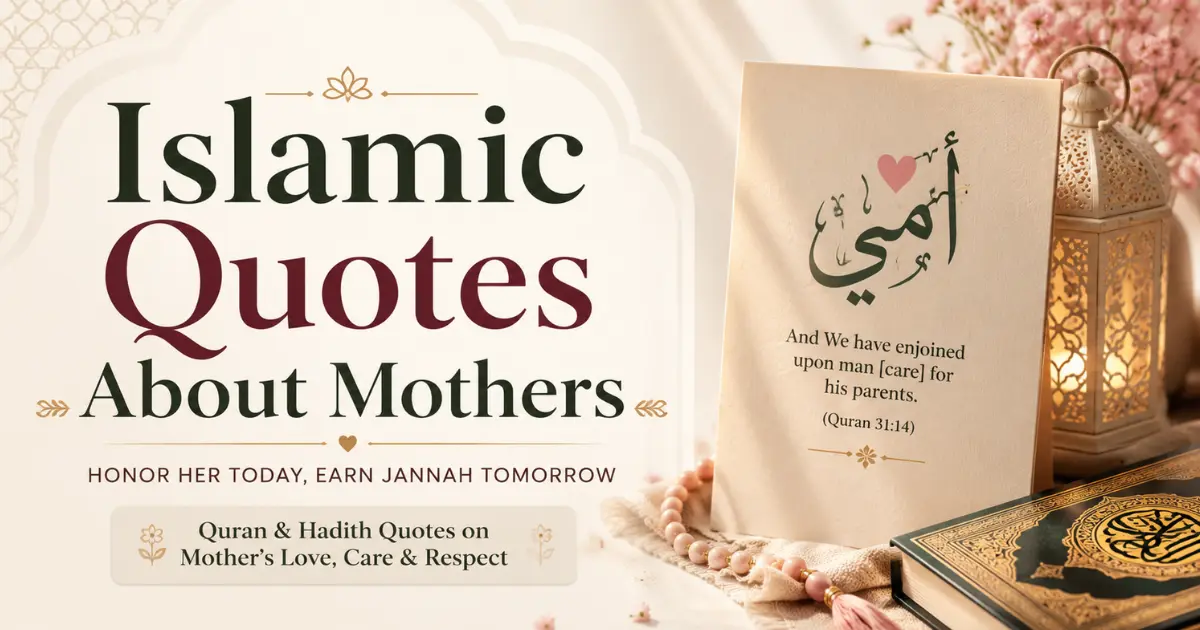
If you searched for “Islamic quotes about mothers,” you’re probably looking for one of two things: something to caption a photo with, or something that actually explains why Islam treats motherhood as sacred ground. This post gives you both — but every quote here is sourced, not recycled from a graphics page with no citation.
Islam doesn’t just say “respect your mother.” It builds an entire legal and spiritual framework around it. That’s what makes these quotes worth more than a caption.
If you really think about it, no relationship in Islam is emphasized as deeply as the bond with your mother. Not just once—but again and again, in the Quran and Hadith, you’re reminded where your priorities should be.
The way you speak to her, care for her, and show patience with her… it all matters more than most people realize.
And if you’ve ever paused to think about what a mother تحملs—pregnancy, sleepless nights, constant sacrifice—it makes those teachings hit even harder. Islam doesn’t just acknowledge that struggle; it elevates it.
In this collection, you’ll find some of the most powerful Islamic quotes about mothers—from the Quran, Hadith, and timeless Islamic wisdom. Not just words to read, but reminders to reflect on—and maybe even act on today.
Quran Verses About Mothers
“My Lord, have mercy upon them as they brought me up when I was small.” (Quran 17:24)
This is the dua Muslims are taught to make for their parents, and it comes right after one of the strongest commands in the Quran: don’t even say “uff” — a single word of irritation — to your parents. The verse before it (17:23) tells you to lower your voice, speak with generosity, and never show them contempt, even in old age when they might repeat themselves or need more from you. The mother isn’t singled out by name in this exact verse, but classical commentators point out she’s the reason the command exists at all — no one absorbs more of a child’s daily impatience than a mother does.
“His mother carried him, increasing her in weakness upon weakness.” (Quran 31:14)
This verse sits inside Luqman’s advice to his son, right where you’d expect a lecture on obeying God. Instead, the Quran pauses to describe pregnancy and nursing — two years of physical depletion — before it even gets to the command to be grateful to your parents. The placement is the point. Gratitude to your mother isn’t a footnote to faith; the Quran treats it as inseparable from gratitude to God.
“His mother bore him with hardship and gave birth to him in hardship.” (Quran 46:15)
A different surah, the same emphasis. This verse goes on to describe a son who reaches maturity and prays, “My Lord, enable me to be grateful for Your favor which You have bestowed upon me and upon my parents.” Two mentions of hardship in one sentence isn’t accidental phrasing — it’s the Quran making sure you don’t skim past what a mother’s body goes through.
Hadith About Mothers
“Your mother, then your mother, then your mother, then your father.” (Sahih al-Bukhari 5971, Sahih Muslim 2548)
A man asked the Prophet ﷺ, “Who is most deserving of my good companionship?” The Prophet said, “Your mother.” The man asked, “Then who?” Same answer: “Your mother.” A third time: “Your mother.” Only on the fourth question did the Prophet say, “Your father.” This hadith is authentic and appears in both Bukhari and Muslim — the two most rigorously verified hadith collections in Islam. It’s not a poetic exaggeration; it’s a direct ranking, given in response to a direct question.
“Paradise lies at the feet of mothers.”
Honesty note: this exact wording is everywhere online, but it’s not found in Bukhari or Muslim in this precise phrasing. The closest authentic basis is a hadith in Sunan an-Nasa’i and Musnad Ahmad, where a man asks permission to go fight in a military campaign, and the Prophet asks if his mother is alive. When told yes, he says to stay and serve her, adding that her feet are where his paradise lies. Scholars differ on the exact grading of that narration, but the underlying principle — that serving your mother can carry the spiritual weight of jihad — is well supported elsewhere. Use the phrase, but know where it actually comes from.
“The best of you is the one who is best to his family, and I am the best of you to my family.” (Sunan Ibn Majah, Sahih)
This one’s about the Prophet ﷺ himself, not a direct quote about mothers specifically — but it’s the standard he set for how a household treats the women in it, mothers included. It’s often paired with accounts of how gently he spoke about his own mother, Amina, who died when he was six, and how he wept at her grave decades later as an adult prophet. Grief for a mother, even a distant one, wasn’t something he outgrew.
Islamic Quotes for Mom from Daughter/Son
Whether you’re a son or daughter, these quotes help you express what’s often hard to say to your mom:
- “Paradise lies at the feet of your mother.” — Prophet Muhammad ﷺ, No matter how far I go in life, I know Jannah begins with how I treat you, Mom.
- “My Lord, have mercy upon them as they brought me up when I was small.” (Quran 17:24), Ya Allah, reward my mother for every silent sacrifice she made for me.
- Your mother, your mother, your mother, then your father.” — Prophet Muhammad ﷺ,If I ever forget your value, this reminder is enough to bring me back.
- Mom, your duas have protected me in ways I’ll never fully understand.
- Everything I am today carries a part of your patience, your strength, and your ایمان.
- Ya Allah, grant my mother the highest place in Jannah, just as she gave me everything in this dunya.
- Mom, even when I didn’t say it enough, your love was always my greatest blessing.
- The older I grow, the more I realize—your sacrifices were أكبر than I ever noticed.
- If kindness had a face in my life, it would look like you, Mom.
- Ya Allah, forgive my mother, bless her with peace, and surround her with Your mercy—today and always.
Short Islamic Quotes About Mothers
- A mother’s dua can open doors that effort alone never could.
- Allah placed His mercy in a mother’s heart—honor it while you can.
- The closest reflection of unconditional love in this الدنيا is a mother.
- Serving your mother is one of the easiest paths to earning Allah’s pleasure.
- Behind every strong believer is often a mother who never stopped making dua.
Emotional Islamic Quotes About Mother’s Love
These emotional Islamic quotes about a mother’s love remind us that her care isn’t ordinary—it’s a reflection of mercy placed in her heart by Allah.
- A mother’s love is one of the purest signs of Allah’s mercy in your life.
- Long before you understood love, your mother was already living it for you every single day.
- The warmth you feel in a mother’s care is a glimpse of the mercy Allah has for His خلق.
- No love in this world gives more and asks for less than a mother’s love.
- Your mother carried your pain before you even knew how to feel it yourself.
- In every silent sacrifice your mother made, there was love only Allah truly witnessed.
- A mother’s heart makes dua for you even when her lips are silent.
- You may outgrow many things in life, but you never outgrow the need for your mother’s love.
- Allah chose her to be your mother—there is no greater proof of how much you are loved.
- If you want to understand sincerity, look at how your mother loves you without conditions.
Islamic Quotes About Respecting Mothers
Respecting your mother in Islam is not optional—it’s deeply connected to your character and your faith.
- Respecting your mother isn’t just good character—it’s جزء of your faith.
- The way you speak to your mother says more about your deen than your words ever could.
- Honor your mother in small moments—because that’s where respect truly shows.
- A lowered voice and a soft heart toward your mother can raise your rank with Allah.
- Respect for your mother is عبادah when it’s done with sincerity.
- If Jannah is under her feet, then respect is the الطريق that leads you there.
- Even when it’s difficult, choosing patience with your mother is a form of obedience to Allah.
- True respect is not just listening to your mother—but valuing her presence and her words.
- The احترام you show your mother today will shape your standing in the akhirah.
- Allah sees every moment you choose kindness over pride with your mother.
What These Quotes Actually Mean for You
A few patterns show up across every verse and hadith on this list, and they matter more than any single quote:
- Physical sacrifice gets named specifically. The Quran doesn’t say “mothers work hard” in the abstract — it names pregnancy, weakness, and hardship directly. That specificity is rare in scripture and it’s deliberate.
- Respect is ranked, not just recommended. The “your mother, three times” hadith isn’t a nice sentiment — it’s the Prophet ﷺ answering a practical question about priorities with a clear, repeated answer.
- Old age is where the real test starts. Quran 17:23 targets the exact moment respect gets hardest — when a parent is old, possibly repetitive, possibly dependent. The command isn’t for when it’s easy.
If you’re sharing one of these quotes, the verse or hadith reference isn’t decoration — it’s what makes it trustworthy instead of just aesthetic.
Why Mothers Are So Important in Islam
- Mothers endure hardship in pregnancy and upbringing
- They are given priority over fathers in companionship
FAQ
“Your mother, then your mother, then your mother, then your father” — from Sahih al-Bukhari and Sahih Muslim — is the most rigorously authenticated hadith specifically about a mother’s status in Islam.
No. It’s not a Quranic verse, and the popular exact wording isn’t in Bukhari or Muslim either. It traces back to a hadith in An-Nasa’i and Ahmad with a similar meaning, involving a son asking about military service.
The Quran doesn’t always use the word “mother” directly, but verses like 31:14 and 46:15 describe pregnancy, nursing, and the physical toll of raising a child — language that points specifically at mothers even when the word itself isn’t used in every line.
Classical scholars point to the physical burden of pregnancy, childbirth, and nursing as the basis — burdens the Quran itself describes in 31:14 and 46:15. The ranking reflects that sacrifice, not a claim that fathers are unimportant elsewhere in Islamic teaching.