Rumi was a 13th-century Persian poet, Islamic scholar, and Sufi mystic who spent most of his life in Konya, in present-day Turkey. He wasn’t writing self-help content — he was writing devotional poetry about longing for the divine, grief, and the strange mechanics of the human heart.
Most of the English lines we now call “Rumi quotes” come from interpretive translations, especially Coleman Barks’s The Essential Rumi, which reshaped his Persian verse into the free-flowing English poetry most readers know today. That matters, because it means the words carry real depth, even filtered through translation and time.
His appeal today isn’t an accident. He wrote about heartbreak, doubt, and searching for meaning eight centuries before “mental health” was a phrase — and somehow it still reads like it was written for exactly the week you’re having.
Below are his most consistently cited lines, sourced primarily from The Essential Rumi and classic Masnavi translations, organized by theme with no quote repeated across sections.
Most Powerful Rumi Quotes
These are the lines that show up most often across anthologies, and for good reason — they compress an entire idea into something you can actually carry with you.
1.
“What you seek is seeking you.”
This flips the usual advice on its head. You’re not chasing something outside yourself — it’s already reaching back.
2.
“The wound is the place where the Light enters you.”
A wound isn’t the point here — it’s the opening. The line never claims pain is good, only that it’s where something else can finally get through.
3.
“This being human is a guest house. Every morning a new arrival.” — The Guest House, from The Essential Rumi
He’s not telling you to avoid hard emotions. He’s telling you to let them visit, then let them leave.
4.
“Out beyond ideas of wrongdoing and rightdoing, there is a field. I’ll meet you there.”
Notice he’s not picking a side. He’s stepping outside the whole framework of sides, which is a different move than compromise.
5.
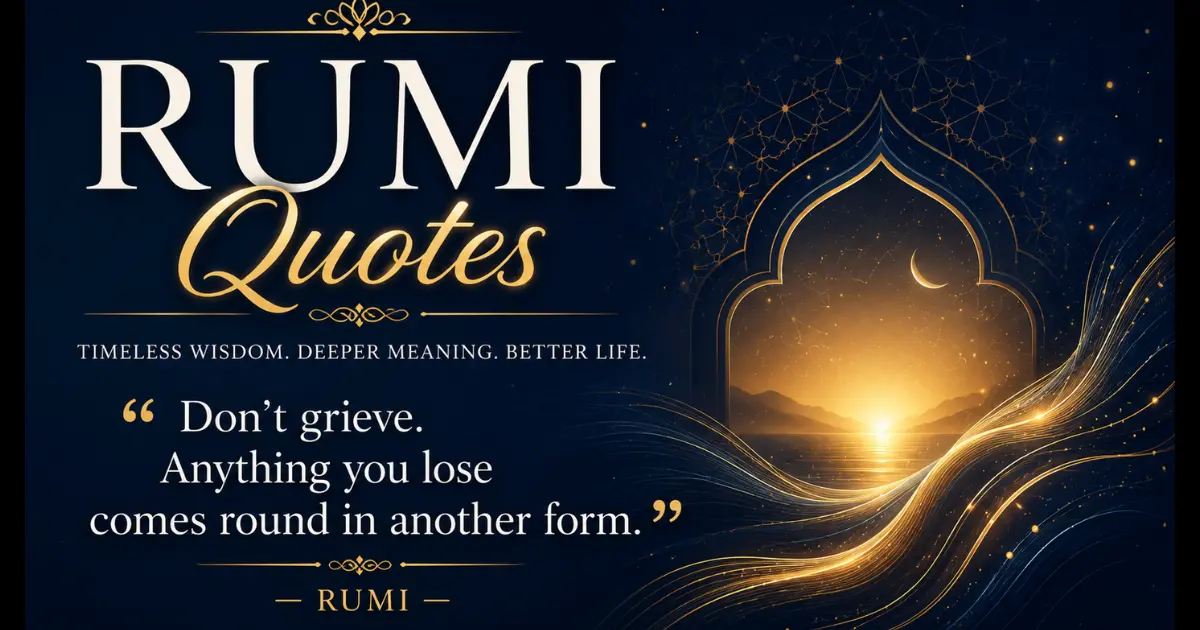
“Don’t grieve. Anything you lose comes round in another form.”
Not a denial that loss hurts. More a reminder that endings rarely stay endings — they usually just change shape.
6.
“Sell your cleverness and buy bewilderment.”
Cleverness wants to have the answer. Bewilderment is willing to actually look. He clearly thought the second one mattered more.
7.
“Where there is ruin, there is hope for treasure.”
He’s pointing at the same spot twice. Collapse and possibility aren’t opposites in this line — they’re stacked on top of each other.
8.
“The minute I heard my first love story, I started looking for you, not knowing how blind that was.” — Story Water, from The Essential Rumi
The “blindness” isn’t about being wrong. It’s about searching outward for something his other lines insist was already internal.
Rumi Quotes on Love
Rumi wrote about love as something closer to gravity than emotion — a force that was already operating on you before you noticed it.
9.
“Lovers don’t finally meet somewhere. They’re in each other all along.” — Story Water, from The Essential Rumi
This undoes the whole idea of a “meet-cute.” Connection, in his telling, was never a discovery — it was a recognition.
10.
“Your task is not to seek for love, but merely to seek and find all the barriers within yourself that you have built against it.”
This is one of his more clinical lines, and it’s the most useful one here. Love isn’t the hard part — clearing what’s blocking it is.
11.
“In your light I learn how to love.”
Short line, but the direction matters. Love here is taught, not just felt — someone else’s presence becomes the classroom.
12.
“There is a candle in your heart, ready to be kindled. There is a void in your soul, ready to be filled.”
Two images doing different jobs — one is dormant potential, the other is open space. Neither needs to be forced, just noticed.
Rumi Quotes on Life
These lines treat ordinary life as something worth paying closer attention to, not something to escape or optimize.
13.
“Try not to resist the changes that come your way. Instead let life live through you.”
Not a call for passivity. It’s a redirection of effort — stop fighting the current, start moving with it instead.
14.
“You have to keep breaking your heart until it opens.”
Not a metaphor for tragedy. A metaphor for repetition — some lessons only land after you’ve been through them more than once.
15.
“The garden of the world has no limits, except in your mind.”
The limit he’s naming isn’t circumstance. It’s perception — a harder thing to fix, but also the only piece actually in your control.
16.
“Let yourself be silently drawn by the strange pull of what you really love. It will not lead you astray.”
He’s granting permission most people never give themselves — to trust an unexplainable pull instead of demanding a reason first.
Rumi Quotes on Self-Discovery & Growth
Growth, in Rumi’s writing, usually starts with admitting you’ve been avoiding something obvious.
17.
“Why do you stay in prison when the door is so wide open?”
The prison he’s describing was never locked from the outside. That’s the detail most people miss on a first read.
18.
“Stop acting so small. You are the universe in ecstatic motion.”
Less about ego, more about scale. He’s arguing you’ve been using the wrong measurements the whole time.
19.
“Respond to every call that excites your spirit.”
Not every impulse — specifically the ones that pull at something deeper. That distinction is easy to skip past.
20.
“You have been walking the ocean’s edge, holding up your robes to keep them dry. You must dive naked under, and deeper under, a thousand times deeper.”
Half-measures get called out directly here. He’s not asking for caution — he’s asking for commitment.
Rumi Quotes on Peace & Inner Calm
This is the section people usually search for at the end of a hard day, and Rumi’s version of calm was never passive — it took active surrender.
21.
“There is a voice that doesn’t use words. Listen.”
A one-line instruction with no elaboration, which is the point. Some things stop working the moment you try to explain them.
22.
“When you do things from your soul, you feel a river moving in you, a joy.”
He’s describing something physical, not just an emotion. Joy, in this line, has motion to it — it isn’t just a mood.
23.
“The moment you accept what troubles you’ve been given, the door will open.”
Acceptance isn’t the finish line here — it’s the unlock. The door only opens after, never before.
24.
“Silence is an ocean. Speech is a river.”
Most people treat silence as the absence of something. He treated it as the source everything else comes from.
Rumi Quotes on Soul & Spirituality
This is closest to what Rumi actually spent his life writing about — not modern mindfulness, but a specific, devotional search for the divine.
25.
“Let the beauty of what you love be what you do.”
This collapses two separate questions — what you love and what you do — into a single decision instead of two.
26.
“The soul has been given its own ears to hear things the mind does not understand.”
A real distinction between knowing and understanding — one is intellectual, the other isn’t, and he trusted the second one more.
27.
“We are born of love; Love is our mother.”
Not romantic love here — closer to origin. He’s naming it as the thing you came from, not something you go find later.
28.
“I am the servant of the Qur’an as long as I have life. I am the dust on the path of Muhammad, the Chosen one.”
This is one of his own verses about his identity, and it’s worth including honestly. He was a devout Muslim scholar first — the “universal mystic” framing common in Western pop culture leaves that part out.
Short Rumi Quotes (One-Line Wisdom)
For when you just want the line, no context required.
- “Everything that is made beautiful and fair and lovely is made for the eye of one who sees.”
- “Reason is powerless in the expression of love.”
- “Grief can be the garden of compassion.”
- “Words are a pretext. It is the inner bond that draws one person to another, not words.”
- “Every moment I shape my destiny with a chisel. I am a carpenter of my own soul.”
- “Knock, and He’ll open the door.”
FAQs About Rumi Quotes
“What you seek is seeking you” is the line most widely recognized in English, largely through Coleman Barks’s popular translations. It’s short enough to apply to almost any kind of searching, which is part of why it’s outlasted so many other lines.
His clearest statement is that the real work isn’t finding love, but clearing the barriers you’ve built against it. He treated love less like an external prize and more like a force already present, waiting for interference to stop.
Because they were written about grief, longing, and searching for meaning — feelings that don’t really change across centuries. His imagery (light, wounds, oceans, guest houses) also translates unusually well into modern English, which is part of why his lines circulate so widely on social media.
Both, honestly. Rumi was a devout Muslim scholar and Sufi mystic, and his original poetry is full of direct references to God, the Qur’an, and Islamic devotion. Many popular English translations soften or remove that context, which is worth knowing if you want to understand where his words actually came from.
No — and this is a bigger problem for Rumi than for almost any other widely quoted historical figure. Several extremely popular lines, including “Yesterday I was clever, so I wanted to change the world. Today I am wise, so I am changing myself,” have no verified source in his actual work and are considered fabricated. Every quote on this page is drawn from recognized translations, primarily The Essential Rumi and classic Masnavi translations.
Final Thoughts: Why Rumi’s Words Still Touch Hearts Today
Rumi wasn’t writing to be quoted on a phone screen eight hundred years later. He was working through grief, devotion, and a very specific spiritual longing, in a language and context most of us will never fully inhabit.
That distance is actually part of why his words still land. They weren’t built for quick comfort. They came out of someone taking his own searching seriously enough to write it down.
Which quote spoke to you most? That’s usually worth sitting with for a minute before you move on.