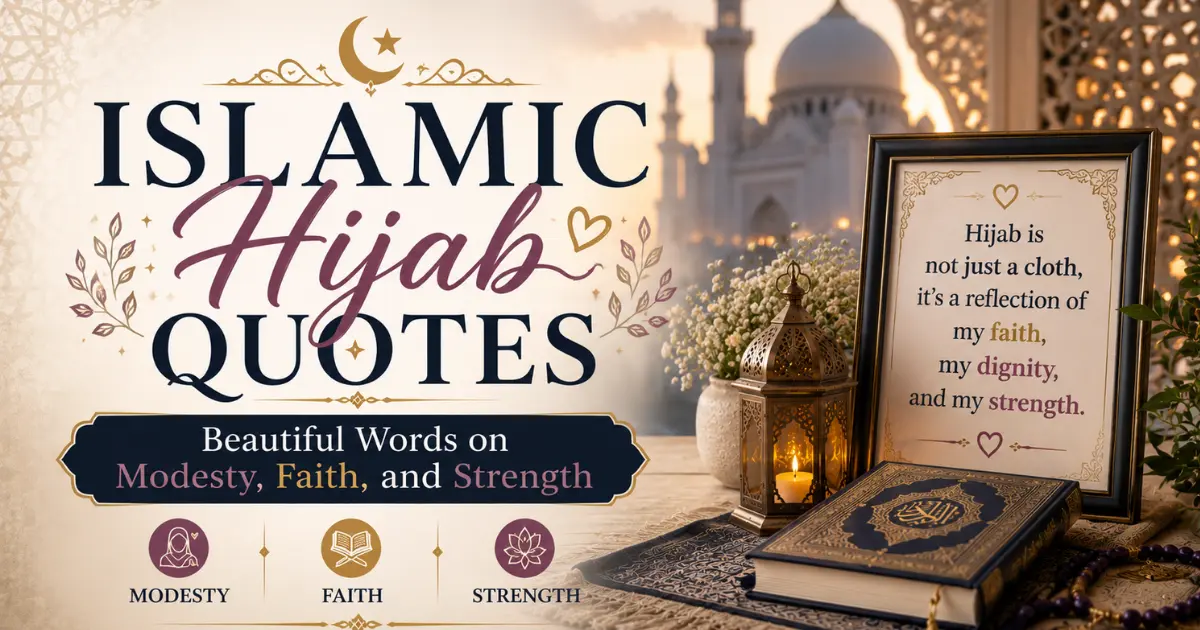
There’s a moment a lot of women who wear hijab know well — the first time someone assumes something about them based on a piece of cloth. Oppressed. Quiet. Old-fashioned. None of it true, but the assumption shows up anyway. What rarely gets talked about is the other side of that story: the confidence, the identity, and the quiet strength that so many women describe finding in hijab, not despite their faith, but because of it.
Hijab in Islam was never meant to be a symbol of restriction. It’s rooted in modesty, dignity, and a direct connection to worship — a personal choice that reflects something deeper than fashion or culture. Whether you’re already wearing hijab, considering it, or just want words that capture what it actually represents, these quotes speak to that meaning honestly.
At dpquotes.com, we pulled together this collection from the Quran, authentic hadith, and reflections that speak specifically to modesty, faith, and the strength it takes to stay consistent in something so personal — especially in spaces where it isn’t always understood.
What Hijab Actually Means in Islam
Hijab is often reduced to a single image — a headscarf — but the concept is broader than that. At its core, hijab refers to modesty as a whole: how a person dresses, yes, but also how they carry themselves, speak, and interact with the world. The physical covering is one visible expression of a much bigger principle rooted in humility before Allah.
It’s also worth saying clearly: hijab, in Islamic teaching, is meant to be a matter of personal conviction, not coercion. The verses addressing modesty are paired throughout the Quran with instructions on lowering the gaze and guarding one’s own conduct — a mutual standard, not a one-sided expectation placed only on women.
Quran Verses About Modesty and Hijab
“And tell the believing women to reduce [some] of their vision and guard their private parts and not expose their adornment except that which [necessarily] appears thereof and to wrap [a portion of] their headcovers over their chests.”
— Surah An-Nur 24:31
This verse is one of the most direct references to hijab in the Quran, but it’s worth noting what comes right before it — a nearly identical instruction directed at believing men, asking them to lower their gaze first. Modesty, in this passage, is framed as a shared responsibility, not something placed on women alone.
“O Prophet, tell your wives and your daughters and the women of the believers to bring down over themselves [part] of their outer garments. That is more suitable that they will be known and not be abused.”
— Surah Al-Ahzab 33:59
This verse ties modesty directly to protection and recognition — being identifiable as a believing woman, and by extension, treated with the respect that identity deserves. It reframes hijab less as concealment and more as a kind of quiet declaration.
“Say to the believing men that they should lower their gaze and guard their modesty.”
— Surah An-Nur 24:30
Often left out of conversations about hijab, this verse comes first in the passage, addressed to men. It’s a reminder that Islamic modesty was never designed as a one-directional expectation — both sides carry responsibility.
Hadith About Modesty and Character
“Modesty is a branch of faith.”
— Sahih Muslim
Short, but foundational. This hadith places modesty within the broader structure of iman itself — not a separate rule, but a natural extension of genuine faith.
“Every religion has a characteristic, and the characteristic of Islam is modesty.”
— Sunan Ibn Majah
This hadith describes modesty as something that defines the entire character of the religion, not just one isolated practice within it. It’s a reminder that hijab connects to a much larger framework of humility and restraint.
“Allah is modest and loves modesty.”
— Sunan Abi Dawood
A simple but striking statement — modesty isn’t just expected of believers, it’s described as a quality Allah Himself embodies and loves to see reflected in His creation.
Quotes on Hijab as an Act of Faith
- Hijab isn’t worn to be seen — it’s worn to be seen the way you choose to be seen.
- Every time the scarf goes on, it’s a quiet renewal of intention, whether anyone else notices or not.
- Covering isn’t about disappearing. It’s about deciding what the world gets to see first — character, not appearance.
- Hijab is one of the few acts of worship that’s visible to everyone and understood by very few.
Quotes on Strength and Identity in Hijab
Wearing hijab, especially somewhere it isn’t the norm, takes a particular kind of resolve. These lines speak to that experience honestly.
- It takes a real kind of confidence to wear your faith where it isn’t always welcomed.
- Hijab doesn’t shrink a woman’s presence — if anything, it makes people notice what she says and does, not just how she looks.
- Every stare that assumes the wrong thing is a reminder of how little the assumption actually knows.
- Strength doesn’t always look loud. Sometimes it looks like walking into a room fully covered and fully sure of yourself anyway.
- Choosing hijab in a world that questions it is its own quiet act of courage.
Quotes on Hijab and Inner Beauty
“Do not turn your cheek [in contempt] toward people, and do not walk through the earth exultantly. Indeed, Allah does not like everyone self-deluded and boastful.”
— Surah Luqman 31:18
While not specifically about hijab, this verse reflects the same underlying value — that true dignity comes from humility, not display. It’s often cited alongside hijab teachings because both point toward the same principle: character over appearance.
- Real beauty was never meant to be something the whole world had access to.
- What hijab covers isn’t beauty — it’s access to it, and that’s a choice worth respecting.
- The most attractive quality Islam asks for isn’t visible at all — it’s humility, kindness, and sincerity.
Hijab Captions for Instagram
Short, meaningful lines for hijab-focused photos, reflections, or everyday posts.
- Covered by choice, confident by faith
- My scarf, my statement of intention
- Modesty isn’t limiting — it’s freeing
- Wrapped in faith, standing in strength
- This is worship you can see
- Choosing Allah’s pleasure over the world’s opinion
- Hijab: my identity, not my restriction
- Strength looks good in every color
Addressing Common Misunderstandings About Hijab
A few honest clarifications worth including, especially for readers newer to the topic:
- Hijab isn’t forced modesty — it’s meant to be a conviction. Islamic teaching is clear that faith, including the choice to wear hijab, should come from sincere belief, not pressure. Coercion contradicts the spirit of the practice entirely.
- It’s not a measure of how “good” a Muslim someone is. A woman’s faith isn’t validated or invalidated by whether she wears hijab. It’s a personal act of worship between her and Allah, not a scoreboard for others to judge.
- It’s not inherently oppressive. Many women describe hijab as empowering — a way of controlling how and when they’re perceived, rather than being constantly evaluated on appearance. That experience deserves to be heard directly from the women living it, rather than assumed from the outside.
- Men are held to a parallel standard. The Quran’s modesty instructions to men come first in the same passage that addresses women, asking for lowered gaze and guarded conduct — a detail that’s easy to miss but important to include.
How to Reflect on These Quotes in Daily Life
A few simple ways to let these words shape more than just a caption:
- Renew your intention regularly, not just on the days hijab feels easy to wear.
- Read the full context of Surah An-Nur 24:30-31, noticing how the instruction to men comes first — it shifts how the passage reads.
- Sit with the modesty hadith during quiet moments, not just as a quote, but as a personal check on how you carry yourself, not only what you wear.
- Talk openly about the strength it takes, especially with younger girls navigating hijab for the first time in spaces that don’t always understand it.
- Remember that consistency matters more than perfection — some days will feel easier than others, and that’s part of the journey, not a failure of it.
FAQs About Islamic Hijab Quotes
Surah An-Nur 24:31 and Surah Al-Ahzab 33:59 are the two primary verses addressing hijab directly, describing modest dress as a means of dignity, recognition, and protection — paired, notably, with a parallel instruction to men in Surah An-Nur 24:30 to lower their gaze first.
Most scholars consider hijab an obligation based on these Quranic verses and supporting hadith, though interpretations and applications vary across different schools of thought and cultural contexts. It’s ultimately meant to be practiced from personal conviction rather than external pressure.
Short, identity-focused lines like “covered by choice, confident by faith” or “this is worship you can see” tend to resonate because they capture both the spiritual and personal meaning behind the choice, without sounding generic.
The broader concept of modesty applies to both men and women. While the physical hijab, as commonly understood, is specifically addressed to women, the Quran pairs it with a direct instruction for men to lower their gaze and guard their own conduct first.
Final Thoughts
Hijab was never meant to shrink a woman’s presence — for so many who wear it, it does the opposite. It becomes a source of identity, a quiet form of worship, and a daily reminder of where their confidence actually comes from. Whatever stage of that journey you’re on, these words are a reminder that hijab was always meant to be about strength, not restriction.
Which of these quotes reflects how you see your own hijab journey? Save it, share it with someone who needs the encouragement, and check back on dpquotes.com — we’re always adding new reflections on faith, modesty, and identity.