Epictetus was an ancient Stoic philosopher whose teachings focused on a practical question: How much of our lives is actually within our power? Born in Hierapolis and enslaved in Rome, he later became a respected philosophy teacher. Unlike many ancient thinkers, he left no surviving writings of his own. His student Arrian recorded his teachings in a collection known as the Discourses and prepared a shorter handbook, the Enchiridion.
Epictetus taught that we cannot always choose what happens to us, but we can work on how we judge situations, make decisions, and respond. His philosophy places particular importance on self-control, personal responsibility, and the kind of freedom that does not depend entirely on wealth, reputation, or other people’s approval.
This collection brings together quotations from the Discourses and the Enchiridion, with source references and straightforward explanations. Because the surviving texts are translations from ancient Greek, wording can vary between editions. We distinguish established quotations from paraphrases and sayings whose attribution cannot be confirmed.
Top picks
The Power of Self-Control
“If you have received the impression of any pleasure, guard yourself against being carried away by it; but let the thing wait for you, and allow yourself a certain delay on your own part.”
— Epictetus, Enchiridion, Section 34
Personal Responsibility
Strength Through Adversity
“It is circumstances (difficulties) which show what men are.”
— Epictetus, Discourses, Book 1, Chapter 24
Understanding What Matters
“Some things are in our control and others not.”
— Epictetus, Enchiridion, Section 1 (George Long translation)
This opening principle captures the central concern of Epictetus’s philosophy. We have responsibility for our choices, judgments, and intentions, but we cannot command every external event or outcome. Learning to recognize that difference is an important step toward greater self-control and a more considered way of living.
Consistency and Personal Growth
“No great thing is created suddenly, any more than a bunch of grapes or a fig.”
— Epictetus, Discourses, Book 1, Chapter 15
On Purpose and Personal Responsibility
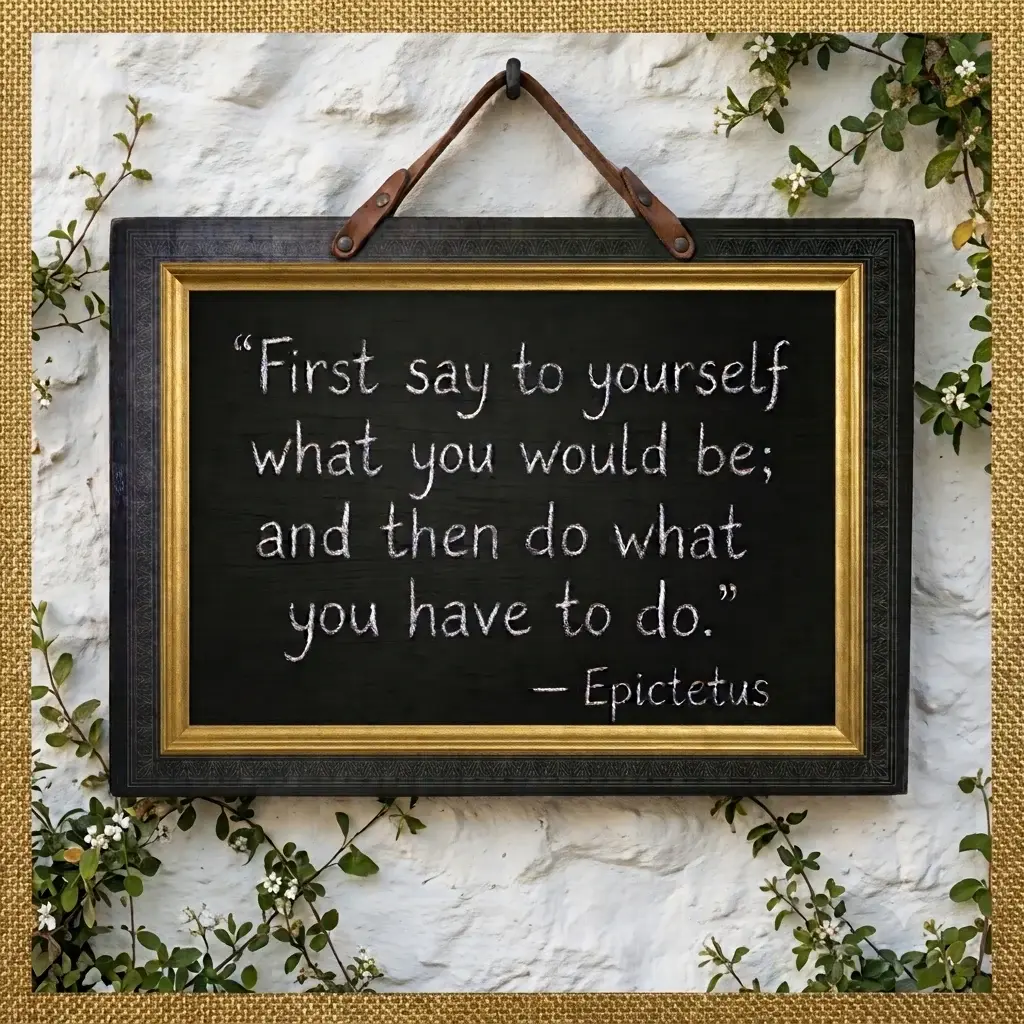
“First say to yourself who you wish to be: then do accordingly what you are doing.”
— Epictetus, Discourses, 3.23
On Overcoming Procrastination
“How long will you wait to think yourself worthy of the highest improvements and follow the distinctions of reason?”
— Epictetus, Enchiridion, 51
On Putting Principles into Practice
“On no occasion call yourself a philosopher, and do not speak much among the uninstructed about theorems (philosophical rules, precepts); but do that which follows from them.”
— Epictetus, Enchiridion, 46
On Focusing on What You Can Control
“We must make the best use that we can of the things which are in our power, and use the rest according to their nature. What is their nature then? As God may please.”
— Epictetus, Discourses, 1.1
Best Epictetus Quotes on Life, Wisdom, and Self-Control
Epictetus’s most memorable teachings are often practical rather than poetic. He asks readers to examine their judgments, take responsibility for their choices, and stop expecting life to follow a preferred script. These selections come from the Enchiridion and the Discourses, with references to the relevant sections.
1. “Men are disturbed not by the things which happen, but by the opinions about the things.”
— Epictetus, Enchiridion, Section 5
What It Means
An event and our judgment of that event are not the same thing. We may not be able to change what happened, but we can examine the meaning we give it and whether our reaction is reasonable.
Why It Matters Today
A difficult conversation, a disappointing result, or an unexpected change can quickly affect our mood. Before reacting, it helps to ask whether we are responding to the facts or to an assumption about what those facts mean.
Editor’s Insight
This is one of Epictetus’s central ideas, but it should not be mistaken for saying that hardship is imaginary or that people can simply think away their pain. His point is that our judgments influence how we respond to circumstances.
2. “Seek not that the things which happen should happen as you wish; but wish the things which happen to be as they are, and you will have a tranquil flow of life.”
— Epictetus, Enchiridion, Section 8
What It Means
Peace becomes harder to find when we insist that every situation must match our expectations. Epictetus encourages us to face what has happened instead of spending our energy wishing reality were different.
Why It Matters Today
Plans change. People disappoint us. Opportunities do not always work out. Accepting that something has happened does not mean approving of it or giving up. It means starting from reality so we can decide what to do next.
Editor’s Insight
Acceptance is not passivity. Epictetus is asking us to stop fighting what cannot be undone and put our effort into the choices still available to us.
3. “On the occasion of every accident (event) that befalls you, remember to turn to yourself and inquire what power you have for turning it to use.”
— Epictetus, Enchiridion, Section 10
What It Means
When something unexpected happens, look for the response or personal quality the situation calls for. A difficult task may require patience; a painful experience may call for endurance; an insulting remark may test your self-control.
Why It Matters Today
It is easy to spend time asking why a problem happened or blaming the people involved. A more useful question is: What can I do constructively now?
Editor’s Insight
Epictetus does not suggest that every setback is secretly a gift. He encourages us to make good use of the circumstances we face, even when we would never have chosen them.
4. “Never say about anything, I have lost it, but say I have restored it.”
— Epictetus, Enchiridion, Section 11
What It Means
Epictetus asks readers to remember that possessions and relationships are not permanent. Instead of treating everything we have as something we can keep forever, we should recognize that life can take it away.
Why It Matters Today
This passage offers a challenging perspective on attachment and impermanence. It reminds us to value what we have without assuming that we have complete control over how long it will remain.
Editor’s Insight
This is a demanding Stoic teaching, not a reason to dismiss grief. Losing someone we love can be deeply painful. The passage is about recognizing life’s uncertainty, not pretending that loss does not matter.
5. “If you would improve, submit to be considered without sense and foolish with respect to externals.”
— Epictetus, Enchiridion, Section 13
What It Means
If personal growth depends on other people’s approval, it becomes difficult to make independent choices. Epictetus advises us not to make reputation, status, or admiration the measure of our progress.
Why It Matters Today
The pressure to look successful can distract us from becoming better at what actually matters. Sometimes meaningful progress means learning quietly, admitting what we do not know, and allowing others to misunderstand us.
Editor’s Insight
This is not an invitation to ignore useful criticism. It is a reminder to distinguish honest feedback from the need to impress everyone.
6. “Whoever then wishes to be free let him neither wish for anything nor avoid anything which depends on others: if he does not observe this rule, he must be a slave.”
— Epictetus, Enchiridion, Section 14
What It Means
When our happiness depends entirely on another person’s decisions, approval, or behavior, we give that person considerable power over our peace of mind. Epictetus connects freedom with learning not to make our well-being dependent on things outside our control.
Why It Matters Today
You can work hard, treat people fairly, and make thoughtful decisions, but you cannot control every response or outcome. Remembering that distinction can help you act with greater independence.
Editor’s Insight
Epictetus is discussing inner freedom and the limits of personal control. He is not saying that relationships, cooperation, or other people’s needs are unimportant.
7. “Remember that in life you ought to behave as at a banquet.”
— Epictetus, Enchiridion, Section 15
What It Means
Epictetus compares life to a shared meal. When something comes your way, receive it with moderation. When it passes to someone else, do not grab for it. When it has not yet arrived, be patient.
Why It Matters Today
The comparison speaks to ambition, opportunity, and desire. We can pursue meaningful goals without becoming resentful when someone else succeeds or impatient when our own opportunity takes time.
Editor’s Insight
The lesson is not to stop striving. It is to approach what life offers with patience, good judgment, and self-restraint rather than entitlement.
8. “Remember that thou art an actor in a play, of such a kind as the teacher (author) may choose.”
— Epictetus, Enchiridion, Section 17
What It Means
Epictetus uses the image of a play to explain that we do not choose every circumstance or role life gives us. What matters is how well we carry out the responsibilities that fall to us.
Why It Matters Today
People face different starting points, responsibilities, and challenges. Comparing your circumstances with someone else’s can distract you from making the best choices available in your own situation.
Editor’s Insight
This metaphor is about responding well to circumstances, not surrendering personal responsibility. We may not choose every role, but we remain responsible for how we conduct ourselves.
9. “When you have decided that a thing ought to be done, and are doing it, never avoid being seen doing it, though the many shall form an unfavorable opinion about it.”
— Epictetus, Enchiridion, Section 35
What It Means
If you have carefully judged that an action is right, do not abandon it simply because other people may criticize you. Their opinion should not automatically outweigh your principles.
Why It Matters Today
Doing the right thing is not always popular. You may need to set a fair boundary, speak honestly, or make a responsible decision that others do not understand.
Editor’s Insight
The important phrase is “ought to be done.” Epictetus is not encouraging stubbornness or ignoring criticism. He is asking us to act from sound judgment rather than fear of disapproval.
10. “On no occasion call yourself a philosopher, and do not speak much among the uninstructed about theorems (philosophical rules, precepts); but do that which follows from them.”
— Epictetus, Enchiridion, Section 46
What It Means
Do not make a show of how much philosophy you know. Put its principles into practice. Your conduct should demonstrate what you have learned more clearly than your claims about yourself.
Why It Matters Today
It is easy to talk about patience, honesty, discipline, or kindness. The real test comes when a situation makes those qualities difficult to practice.
Editor’s Insight
This teaching offers a useful standard for personal growth: measure progress by changes in behavior, not by how confidently you talk about self-improvement.
Epictetus Quotes About Control
One of Epictetus’s most important teachings is the distinction between what belongs to our own choices and what depends on circumstances beyond us. He did not teach that we can control every outcome or simply command our emotions to change. His focus was on exercising sound judgment, choosing our actions, and responding responsibly to what happens.
These passages explore that distinction from different angles.
1. “You can be invincible, if you never enter into any contest in which it is not in your power to conquer.”
— Epictetus, Enchiridion, Section 19
What It Means
Epictetus is asking us to be careful about where we place our sense of success. If we measure ourselves by wealth, status, popularity, or another person’s approval, we are competing for outcomes we cannot fully control. A more dependable measure is the quality of our own choices and conduct.
Why It Matters Today
You can prepare thoroughly for an opportunity, but you cannot guarantee the result. You can treat people well, but you cannot make everyone like you. Focusing on what you can genuinely influence helps you avoid turning every external outcome into a judgment of your worth.
Editor’s Insight
This is not advice to avoid challenges. It is a reminder to choose the right measure of victory. Give your best effort, but do not make your peace depend on winning something that was never entirely yours to decide.
2. “If any person was intending to put your body in the power of any man whom you fell in with on the way, you would be vexed; but that you put your understanding in the power of any man whom you meet, so that if he should revile you, it is disturbed and troubled, are you not ashamed of this?”
— Epictetus, Enchiridion, Section 28
What It Means
Epictetus compares physical control with the control we allow others to have over our judgment. His point is that an insult does not have to dictate our response. We can pause, examine what was said, and decide whether it deserves our attention.
Why It Matters Today
A rude comment, harsh criticism, or disagreement can occupy your thoughts long after the conversation ends. Instead of letting another person’s words determine your next move, consider whether the criticism is useful, unfair, or simply not worth carrying.
Editor’s Insight
This passage is not a reason to accept mistreatment or remain silent about wrongdoing. It is about protecting your judgment while deciding how best to respond.
3. “When a raven croaks an unlucky omen, let not the appearance carry you away, but immediately make a distinction within yourself, and say, None of these things is signified to me; but either to my poor body, or property, or reputation, or children, or wife.”
— Epictetus, Enchiridion, Section 18
What It Means
Epictetus uses the ancient belief in omens to make a point about fearful impressions. An unsettling sign does not determine what will happen or what kind of person you will be. What matters is how you judge the impression and respond to it.
Why It Matters Today
We often treat uncertainty as if it were proof that something bad is about to happen. A delayed message, an unexpected change, or an uncertain result can trigger assumptions before we have the facts. This passage encourages us to pause rather than let an impression become a certainty.
Editor’s Insight
The historical reference is to ancient divination, not modern evidence about omens. The enduring philosophical point is to examine an impression before allowing it to govern your choices.
4. “What then should a man have in readiness in such circumstances? What else than this? What is mine, and what is not mine; and what is permitted to me, and what is not permitted to me.”
— Epictetus, Discourses, Book 1, Chapter 1
What It Means
Epictetus encourages us to distinguish between what belongs to our own agency and what does not. We may face restrictions, losses, or difficult circumstances, but we still need to consider which choices remain available to us.
Why It Matters Today
When a problem feels overwhelming, it helps to separate the facts from the decisions still in front of you. You may not be able to change another person’s behavior or undo a setback, but you can decide what responsible action to take next.
Editor’s Insight
This is the practical heart of Epictetus’s approach to control: understand the limits of your power without neglecting the responsibilities that remain yours.
5. “For if he attempts to avoid anything independent of his will, he knows that sometimes he will fall in with something which he wishes to avoid, and he will be unhappy.”
— Epictetus, Discourses, Book 1, Chapter 4
What It Means
Epictetus warns against placing our well-being in things that do not depend on our choices. If we build our peace around avoiding every disappointment, difficulty, or unwanted event, life will repeatedly frustrate that expectation.
Why It Matters Today
You cannot arrange life so that every plan succeeds and every uncomfortable situation disappears. You can, however, prepare carefully, make thoughtful decisions, and respond with integrity when circumstances do not go as expected.
Editor’s Insight
The lesson is not to stop avoiding genuine danger or preventable harm. It is to recognize the difference between sensible action and demanding complete control over life’s outcomes.
Epictetus Quotes About Freedom and Independence
What does it really mean to be free? For Epictetus, freedom is more than wealth, social position, or the ability to do whatever we want. A person can have influence and material comfort yet remain controlled by fear, desire, or the need for approval.
His teachings connect genuine freedom with sound judgment and the ability to govern our own choices.
1. “He is free who lives as he wishes to live; who is neither subject to compulsion nor to hindrance, nor to force; whose movements to action are not impeded, whose desires attain their purpose, and who does not fall into that which he would avoid.”
— Epictetus, Discourses, Book 4, Chapter 1
What It Means
Epictetus describes freedom as the ability to live without being ruled by forces that control our choices. This does not mean getting everything we want. It means learning to want what is consistent with reason and virtue, rather than depending on circumstances we cannot command.
Why It Matters Today
A person may have money, professional success, and social influence but still feel trapped by the need to impress others or protect a particular image. External success does not automatically create independence. How we manage our desires and decisions matters just as much.
Editor’s Insight
Epictetus challenges us to look beyond appearances. Instead of asking how much freedom we have in the outside world, we can also ask how often fear, approval, or uncontrolled desire dictates our choices.
2. “For freedom is acquired not by the full possession of the things which are desired, but by removing the desire.”
— Epictetus, Discourses, Book 4, Chapter 1
What It Means
Getting everything we want may bring temporary satisfaction, but it does not guarantee lasting freedom. New desires can quickly take the place of fulfilled ones. Epictetus argues that independence comes from examining and reducing desires that make our well-being depend on external possessions or circumstances.
Why It Matters Today
It is easy to believe that the next promotion, purchase, achievement, or milestone will finally make life feel complete. Yet satisfaction can remain out of reach when every achievement creates another requirement for happiness.
Editor’s Insight
This teaching is not an argument against ambition or enjoying life’s comforts. It asks us to notice when wanting more begins to control us instead of giving direction to our lives.
3. “What else is freedom but the power to live as we choose?”
— Epictetus, Discourses, Book 2, Chapter 1
What It Means
Epictetus connects freedom with the ability to live according to our considered choices. But he does not equate freedom with doing whatever feels good in the moment. A life directed by impulse, fear, or wrongdoing is not truly independent.
Why It Matters Today
Real independence involves more than having options. It also means having the judgment and self-discipline to choose responsibly. You may have the freedom to react angrily, seek approval, or follow every impulse, but choosing not to do so can be a stronger expression of independence.
Editor’s Insight
Freedom without sound judgment can become another form of dependence. Epictetus reminds us that the quality of our choices matters more than simply having choices.
Epictetus Quotes About Judgment and Perception
Epictetus believed that our first impression of a situation deserves examination, not automatic acceptance. Something may appear unfair, threatening, or unbearable at first. But before reacting, we can pause and consider whether our judgment is based on facts or an assumption.
This distinction is central to his philosophy. It is not about pretending that difficult situations are pleasant. It is about learning to think clearly before allowing an impression to determine our actions.
1. “What is the reason that we assent to anything? The fact that it appears to us to be so.”
— Epictetus, Discourses, Book 1, Chapter 28 (George Long translation)
What It Means
We tend to accept an idea when it appears convincing to us. But something seeming true does not necessarily make it true. Epictetus asks us to understand how easily an impression can influence our judgment.
Why It Matters Today
A rumor, an online post, or a quick assumption about someone’s behavior can feel convincing before we have checked the facts. Taking a moment to question our first impression can prevent unnecessary conflict and poor decisions.
Editor’s Insight
Good judgment begins when we stop treating our first reaction as the final answer. A little patience can make the difference between understanding a situation and misunderstanding it.
2. “When then any man assents to that which is false, be assured that he did not intend to assent to it as false, for every soul is unwillingly deprived of the truth, as Plato says; but the falsity seemed to him to be true.”
— Epictetus, Discourses, Book 1, Chapter 28 (George Long translation)
What It Means
Epictetus suggests that people generally accept what they believe to be true. When someone makes a mistaken judgment, the person may be acting on an impression that appears convincing rather than deliberately choosing what is false.
Why It Matters Today
This offers a useful perspective during disagreements. Instead of immediately assuming that someone is dishonest or unreasonable, consider whether they may be working from incomplete information or a mistaken understanding.
Editor’s Insight
Understanding why someone believes something does not mean agreeing with them or excusing harmful behavior. It simply gives us a better starting point for responding thoughtfully.
3. “There is then nothing like scales (balance), nothing like a rule: but some appearance is presented, and straightway I act according to it.”
— Epictetus, Discourses, Book 1, Chapter 28 (George Long translation)
What It Means
Epictetus criticizes the habit of making important decisions without carefully examining the evidence. We use standards to judge measurements and practical matters, yet we can be surprisingly careless when judging what is right or wrong.
Why It Matters Today
A moment of anger can make a minor disagreement feel like a serious personal attack. Fear can make an uncertain situation seem dangerous. Before making a decision, ask what you actually know and what you may simply be assuming.
Editor’s Insight
Clear thinking requires a standard. Rather than letting every strong impression dictate your response, give important decisions the attention they deserve.
4. “Wait for me a little, impression. Let me see what you are, and what you are an impression of; let me put you to the test.”
— Epictetus, Discourses, Book 2, Chapter 18 (George Long translation)
What It Means
Epictetus offers a practical way to deal with a powerful first impression: pause before following it. Instead of reacting immediately, examine what triggered the impression and whether it deserves your agreement.
Why It Matters Today
When a message upsets you or a situation makes you angry, an immediate response may make things worse. Taking a moment to consider what happened, what you know, and what remains uncertain can help you choose a more measured response.
Editor’s Insight
The pause is not avoidance. It is an opportunity to regain perspective before acting. Sometimes the most thoughtful response begins with giving yourself a moment to think
Epictetus Quotes About Self-Control and Discipline
Epictetus believed that self-control develops through practice, not simply through knowing what is right. A person may understand the value of patience, restraint, or good judgment, but those qualities become meaningful when they guide everyday behavior.
His teachings encourage us to pay attention to our habits, examine our desires, and practice doing what reason asks of us—even when it is difficult.
1. “If you have received the impression of any pleasure, guard yourself against being carried away by it; but let the thing wait for you, and allow yourself a certain delay on your own part.”
— Epictetus, Enchiridion, Section 34 (George Long translation)
What It Means
Epictetus advises us not to follow every attractive impulse immediately. When something promises pleasure, pause and consider what may follow. A moment of restraint can help us make a decision we will still respect later.
Why It Matters Today
An impulse purchase, an unnecessary argument, or a habit we are trying to change can feel difficult to resist in the moment. Giving yourself time before acting creates room to consider the consequences rather than letting immediate desire make the decision.
Editor’s Insight
Self-control does not always require a dramatic act of willpower. Sometimes it begins with a simple pause between wanting something and choosing whether to pursue it.
2. “In walking about as you take care not to step on a nail or to sprain your foot, so take care not to damage your own ruling faculty.”
— Epictetus, Enchiridion, Section 38 (George Long translation)
What It Means
We naturally protect our bodies from physical harm. Epictetus asks us to show similar care toward our faculty of judgment—the part of us responsible for evaluating situations and making choices.
Why It Matters Today
Careless reactions, resentment, dishonesty, and repeated poor decisions can weaken our ability to think clearly. Paying attention to how we respond to everyday situations helps protect the judgment we rely on.
Editor’s Insight
We often notice physical discomfort immediately but overlook the effect of our own behavior on our character. Epictetus reminds us that good judgment deserves daily attention.
3. “The condition and characteristic of a philosopher is this: he expects all advantage and all harm from himself.”
— Epictetus, Enchiridion, Section 48 (George Long translation)
What It Means
Epictetus contrasts a person who constantly looks outside for the cause of success or failure with someone who examines their own choices. The philosophical student takes responsibility for personal conduct rather than making other people responsible for every outcome.
Why It Matters Today
When a project goes wrong or a relationship becomes difficult, blaming others may feel easier than examining our own part. Taking responsibility does not mean accepting blame for everything. It means being honest about what we could have done differently.
Editor’s Insight
Personal responsibility begins with self-examination. We cannot always change the circumstances around us, but we can become more thoughtful about the decisions we make within them.
4. “For since it is impossible without great and constant training to secure that our desire fail not to attain, and our aversion fall not into what it would avoid, be assured that, if you allow training to turn outwards, towards the things that are not in the realm of the moral purpose, you will have neither your desire successful in attaining what it would, nor your aversion successful in avoiding what it would.”
— Epictetus, Discourses, Book 3, Chapter 12 (George Long translation)
What It Means
Epictetus explains that self-discipline requires regular practice. If we train ourselves to depend on external things for satisfaction, we remain vulnerable to circumstances we cannot command. Our practice should instead strengthen our choices and judgment.
Why It Matters Today
Building a habit takes more than good intentions. Whether you are trying to become more patient, resist an unhealthy pattern, or follow through on a responsibility, consistent practice matters more than occasional enthusiasm.
Editor’s Insight
Discipline is not about performing difficult tasks to impress others. It is about training the qualities that help us make better choices when life tests us.
5. “When you have remitted your attention for a short time, do not imagine this: that you will recover it when you choose.”
— Epictetus, Discourses, Book 4, Chapter 12 (George Long translation)
What It Means
Epictetus warns that neglecting self-discipline can become a habit. When we repeatedly postpone attention to our choices and responsibilities, returning to a more deliberate way of living can become harder.
Why It Matters Today
It is easy to put off a responsibility, abandon a useful routine, or tell ourselves that we will become more disciplined tomorrow. Small delays can gradually become patterns that interfere with the goals we care about.
Editor’s Insight
Consistency is built through attention to ordinary moments. We do not need to get everything right every day, but we should be careful about making neglect our usual response.
Epictetus Quotes About Adversity and Difficult Times
Difficult circumstances can reveal how we respond when life does not go according to plan. Epictetus believed that challenges provide opportunities to practice courage, patience, and sound judgment.
His philosophy does not ask us to seek suffering or ignore genuine hardship. It asks us to consider how we can respond wisely when difficult situations are beyond our choosing.
1. “It is circumstances (difficulties) which show what men are.”
— Epictetus, Discourses, Book 1, Chapter 24 (George Long translation)
What It Means
Our character becomes easier to see when circumstances test us. It is one thing to talk about patience, courage, and integrity when life is comfortable. It is another to practice those qualities when we face disappointment, pressure, or uncertainty.
Why It Matters Today
A setback at work, a disagreement with someone close to you, or an unexpected change can test your usual way of responding. These moments give you a chance to notice your habits and decide whether your actions reflect the person you want to become.
Editor’s Insight
A difficult moment does not define your entire character. What matters is whether you use the experience to recognize where you need greater patience, better judgment, or more courage.
2. “Now is the time for the fever.”
— Epictetus, Discourses, Book 3, Chapter 10 (George Long translation)
What It Means
Epictetus uses illness as an example of a moment when philosophical practice must become real. It is easy to talk about patience and self-discipline when everything is going well. The real test comes when circumstances make those qualities harder to maintain.
Why It Matters Today
You may understand the importance of staying calm, but illness, disappointment, or personal difficulties can challenge that understanding. Rather than waiting for life to become comfortable before practicing what you believe, try to bring thoughtful judgment to the situation you are facing now.
Editor’s Insight
The passage is not telling anyone to ignore illness or refuse medical care. Epictetus is emphasizing that difficult circumstances do not have to prevent us from practicing patience, responsibility, and sound judgment.
Epictetus Quotes About Happiness and Contentment
For Epictetus, happiness was not something to be found in wealth, recognition, or a life without difficulties. He believed that a more dependable sense of well-being comes from sound judgment, virtuous conduct, and freedom from desires that make us dependent on external circumstances.
His teachings invite us to reconsider what we expect from life and where we look for lasting contentment.
1. “There is only one way to happiness, and let this rule be ready both in the morning and during the day and by night.”
— Epictetus, Discourses, Book 4, Chapter 4 (George Long translation)
What It Means
Epictetus introduces a central principle: do not make happiness depend on things outside your power. In the surrounding passage, he explains that we should direct our attention toward what belongs to our own choices and judgment rather than becoming consumed by external rewards or circumstances.
Why It Matters Today
It is easy to postpone happiness until a particular goal is achieved, a financial situation improves, or someone gives us the approval we want. Working toward those goals is reasonable, but making our entire sense of well-being depend on them can leave us constantly dissatisfied.
Editor’s Insight
The full passage matters more than the opening sentence alone. Epictetus is not offering a quick formula for happiness; he is describing a way of living that places greater importance on character and judgment than on external success.
2. “But you ought when you are alone to call this condition by the name of tranquillity and freedom, and to think yourself like to the gods; and when you are with many, you ought not to call it crowd, nor trouble, nor uneasiness, but festival and assembly, and so accept all contentedly.”
— Epictetus, Discourses, Book 1, Chapter 12 (George Long translation)
What It Means
Epictetus challenges the habit of treating solitude as loneliness and company as an inconvenience. He encourages a more thoughtful attitude toward both situations: learn to be at ease when alone and to live cooperatively when among others.
Why It Matters Today
Some people feel uncomfortable spending time alone, while others become frustrated whenever life involves too many people or demands. This passage encourages us to develop a more balanced attitude rather than allowing our surroundings to determine our entire state of mind.
Editor’s Insight
Contentment does not mean withdrawing from people or pretending every social situation is pleasant. It means learning to meet different circumstances with greater steadiness and consideration.
3. “What is the product of virtue? Tranquillity.”
— Epictetus, Discourses, Book 1, Chapter 4 (George Long translation)
What It Means
Epictetus connects a good life with the practice of virtue. Knowledge alone is not enough. What matters is whether our choices and conduct reflect qualities such as fairness, self-control, courage, and sound judgment.
Why It Matters Today
A person can achieve professional success, earn recognition, and accumulate possessions without feeling at peace. Epictetus reminds us that a meaningful life also depends on how we treat people, handle responsibilities, and make decisions when doing the right thing is difficult.
Editor’s Insight
Tranquillity, in this context, is not constant happiness or freedom from every difficult emotion. It is the steadiness that comes from living with greater wisdom and integrity.
Epictetus Quotes About Life
Epictetus believed that living well requires more than good intentions. We need to think carefully about our decisions, understand the responsibilities that come with them, and consider the consequences before committing ourselves.
His teachings encourage a deliberate approach to life: choose thoughtfully, act responsibly, and give your decisions the attention they deserve.
1. “In every act observe the things which come first, and those which follow it; and so proceed to the act.”
— Epictetus, Enchiridion, Section 29 (George Long translation)
What It Means
Before committing to something, consider what it requires and what may follow. Epictetus explains that people often begin with enthusiasm without thinking through the effort, discipline, or difficulties involved. When those challenges appear, they may give up.
Why It Matters Today
Starting a business, pursuing a degree, changing careers, or taking on a major responsibility can sound exciting. But every meaningful commitment comes with demands. Thinking through those demands beforehand helps you make decisions with realistic expectations.
Editor’s Insight
Enthusiasm can help you begin, but thoughtful preparation helps you follow through. A good decision considers not only what you hope to gain but also what you are willing to do to achieve it.
2. “Duties are universally measured by relations.”
— Epictetus, Enchiridion, Section 30 (George Long translation)
What It Means
Epictetus explains that our responsibilities depend partly on our relationships and roles in life. Being a parent, sibling, neighbor, or citizen brings responsibilities that call for appropriate conduct. He encourages us to consider what our role requires rather than focusing only on what other people do.
Why It Matters Today
Life involves responsibilities to people beyond ourselves. Being a dependable family member, treating neighbors fairly, and fulfilling professional commitments all require more than personal ambition. They call for consideration and responsible action.
Editor’s Insight
A meaningful life is not built around personal freedom alone. It also involves recognizing our responsibilities and treating the people connected to us with fairness and care.
3. “Immediately prescribe some character and some form to yourself, which you shall observe both when you are alone and when you meet with men.”
— Epictetus, Enchiridion, Section 33 (George Long translation)
What It Means
Epictetus encourages readers to establish principles for their conduct and follow them consistently. Our behavior should not depend entirely on who is watching or what we hope to gain from a situation.
Why It Matters Today
It is easy to behave responsibly in public while making different choices in private. This passage invites us to develop standards that guide our actions in both settings, whether we are dealing with family, colleagues, or our own personal responsibilities.
Editor’s Insight
Integrity is not simply about making a good impression. It is about building consistency between what we believe and how we actually live.
Epictetus Quotes on Fear and Anxiety
Epictetus did not teach that people should never feel fear, sadness, or distress. His philosophy asks us to examine the judgments that intensify those feelings and to respond with greater care. These passages offer a practical way to think about emotional reactions without pretending that difficult experiences do not hurt.
1. “When you see a person weeping in sorrow either when a child goes abroad or when he is dead, or when the man has lost his property, take care that the appearance do not hurry you away with it, as if he were suffering in external things.”
— Epictetus, Enchiridion, Section 16, translated by George Long
What It Means: Epictetus encourages us to distinguish between an event and the judgment we form about it. He is not denying that loss causes pain. He is asking us to look more carefully at how our interpretation shapes our distress.
Why It Matters Today: When something goes wrong, our first reaction can make the situation feel even more overwhelming. Taking a moment to understand what happened—and what we are telling ourselves about it—can help us respond more thoughtfully.
Editor’s Insight: Emotional strength does not require indifference. Epictetus also says we should show sympathy to someone who is grieving. His point is to offer compassion without allowing another person’s distress to overwhelm our own judgment.
2. “Remember that it is not he who reviles you or strikes you, who insults you, but it is your opinion about these things as being insulting.”
— Epictetus, Enchiridion, Section 20, translated by George Long
What It Means: Another person’s words or actions can be hurtful, but our judgment influences how we respond. Epictetus asks us to pause before allowing anger or humiliation to take control.
Why It Matters Today: Criticism, rude comments, and disagreements are part of everyday life. A brief pause can help us decide whether to respond, set a boundary, or walk away instead of reacting impulsively.
Editor’s Insight: This teaching is about managing our response, not excusing mistreatment. Recognizing our own judgment does not mean accepting abuse or pretending harmful behavior is acceptable.
3. “Let death and exile and every other thing which appears dreadful be daily before your eyes; but most of all death: and you will never think of anything mean nor will you desire anything extravagantly.”
— Epictetus, Enchiridion, Section 21, translated by George Long
What It Means: Epictetus asks readers to remember that life is temporary. Rather than treating this awareness as a reason for despair, he uses it to put everyday worries, status, and excessive desires into perspective.
Why It Matters Today: Remembering that time is limited can help us reconsider what deserves our attention. It may encourage us to spend less energy chasing approval and more time acting according to our values.
Editor’s Insight: This is a reflection on mortality, not an invitation to live in fear of death. For Epictetus, remembering life’s limits can make our choices more deliberate and help us focus on what matters.
Epictetus Quotes on Wisdom and Learning
For Epictetus, wisdom was not simply knowing philosophical ideas or being able to discuss them. It meant examining what we believe, recognizing what we do not know, and putting sound principles into practice. These passages show why learning, self-examination, and thoughtful action belong together.
1. “The beginning of philosophy, at least to such as enter upon it in a proper way, and by the door, is a consciousness of our own weakness and inability in necessary things.”
— Epictetus, Discourses, Book 2, Chapter 11, translated by George Long
What It Means: Genuine learning begins when we recognize the limits of our knowledge. Instead of assuming we already understand everything, we become willing to question ourselves and learn.
Why It Matters Today: Whether you’re developing a skill, building a career, or trying to understand another person, progress starts with an honest assessment of what you still need to learn.
Editor’s Insight: Confidence is valuable, but the willingness to admit what we don’t know makes room for real growth.
2. “Education is the learning how to adapt the natural præcognitions to the particular things conformably to nature; and then to distinguish that of things some are in our power, but others are not.”
— Epictetus, Discourses, Book 1, Chapter 22, translated by George Long
What It Means: Education is more than memorizing principles. It involves learning how to apply our basic understanding of right and wrong to real situations—and recognizing where our choices have influence.
Why It Matters Today: Knowing what patience, fairness, or responsibility means is one thing. Practicing those values when circumstances become difficult is another.
Editor’s Insight: Knowledge becomes useful when it changes the way we make decisions.
3. “In theory there is nothing which draws us away from following what is taught; but in the matters of life, many are the things which distract us.”
— Epictetus, Discourses, Book 1, Chapter 26, translated by George Long
What It Means: Understanding a good principle is often easier than living by it. Everyday pressures, emotions, and competing desires can make it difficult to follow what we already know is right.
Why It Matters Today: You may understand the value of patience but struggle to remain patient during an argument. You may know that consistency matters but find it difficult to maintain a habit. The challenge is putting knowledge into action.
Editor’s Insight: Don’t measure growth only by what you know. Pay attention to what you consistently practice.
4. “It is not easy to persuade the young; for they are accustomed to be persuaded by examples rather than by reasons.”
— Epictetus, Discourses, Book 2, Chapter 17, translated by George Long
What It Means: People often learn more from what they see others do than from what they are told. Actions can make a principle easier to understand than an explanation alone.
Why It Matters Today: This is especially relevant to parenting, teaching, and leadership. If we want others to value honesty, kindness, or responsibility, our own behavior should reflect those qualities.
Editor’s Insight: The most convincing lesson is often the one people can see in practice
Epictetus Quotes on Relationships and Human Conduct
Epictetus believed that philosophy should shape the way we treat other people. Friendship, family relationships, and social responsibilities were not separate from personal character. They were opportunities to practice honesty, fairness, patience, and self-control.
1. “For where else is friendship but where faith and honour are, where men give and take what is good, and nothing else?”
— Epictetus, Discourses, Book 2, Chapter 22, translated by Thomas Wentworth Higginson
What It Means: Genuine friendship rests on trust, integrity, and mutual respect. It is more than shared interests or spending time together. A meaningful friendship allows both people to value what is right rather than treating the relationship as a way to gain personal advantage.
Why It Matters Today: A lasting friendship needs honesty and reliability. People may disagree or go through difficult periods, but mutual respect and good intentions help keep the relationship strong.
Editor’s Insight: The quality of a friendship is not measured only by how long two people have known each other. It is also reflected in how they treat one another.
2. “What a man applies himself to earnestly, that he naturally loves.”
— Epictetus, Discourses, Book 2, Chapter 22, translated by George Long
What It Means: The things we consistently give our attention and effort to often become important to us. Epictetus uses this idea to explore the connection between what people value and whom or what they love.
Why It Matters Today: Relationships need attention. Making time to listen, keeping promises, and showing consideration are practical ways to demonstrate that someone matters to us.
Editor’s Insight: Affection is meaningful, but it becomes more dependable when our actions consistently reflect it.
3. “For if we lay aside this fidelity for which we are formed and make designs against our neighbour’s wife, what are we doing? What else but destroying and overthrowing?”
— Epictetus, Discourses, Book 2, Chapter 4, translated by George Long
What It Means: Epictetus presents fidelity as an essential part of human character and social life. Betraying another person’s trust damages more than one relationship; it also weakens the sense of responsibility that allows people to live together.
Why It Matters Today: Trust matters in friendships, families, workplaces, and communities. Honesty and respect for other people’s relationships help create a healthier environment for everyone.
Editor’s Insight: Good character is not demonstrated only by what we say about our values. It is demonstrated by the choices we make when keeping our word requires effort.
Short Epictetus Quotes
Epictetus often expressed deep philosophical ideas through simple, memorable observations. These short quotes offer practical reminders about perspective, judgment, and personal growth.
1. “Every thing has two handles, the one by which it may be borne, the other by which it may not.”
— Epictetus, Enchiridion, Section 43, translated by George Long
Meaning: We can approach a difficult situation from different perspectives. Choosing a more thoughtful perspective can make it easier to respond without unnecessary anger.
2. “But you are neither possession nor speech.”
— Epictetus, Enchiridion, Section 44, translated by George Long
Meaning: Your worth is not determined by how much money you have or how eloquently you speak. Your character cannot be measured by possessions or outward abilities.
3. “For before you shall have determined the opinion, how do you know whether he is acting wrong?”
— Epictetus, Enchiridion, Section 45, translated by George Long
Meaning: Avoid rushing to judge someone else’s behavior. First understand what actually happened instead of immediately assuming the worst.
4. “Now is the contest, now are the Olympic games.”
— Epictetus, Enchiridion, Section 51, translated by George Long
Meaning: The opportunity to practice what you believe is in the present. Personal growth cannot depend on endlessly postponing the effort until a more convenient time.
Who Was Epictetus?
Epictetus (c. 50–135 CE) was a Greek Stoic philosopher whose teachings focused on personal responsibility, self-discipline, and the freedom that comes from governing our own judgments and choices. He was born in Hierapolis, in the region of Phrygia, in what is now modern-day Turkey. He later lived in Rome, where he was enslaved before eventually gaining his freedom.
Epictetus studied Stoic philosophy under Musonius Rufus, a respected Roman Stoic teacher. After receiving his freedom, he taught philosophy in Rome. Following the expulsion of philosophers from Rome under Emperor Domitian, he established a school in Nicopolis, in northwestern Greece.
Unlike some ancient philosophers, Epictetus left no surviving books written in his own hand. His student Arrian recorded his teachings in the Discourses. Arrian also prepared the shorter Enchiridion, commonly known as the Handbook, which presents a concise selection of practical Stoic teachings.
Epictetus’s central message was straightforward but demanding: we cannot control every event in life, but we can work on our judgments, intentions, and actions. He believed that genuine freedom comes from developing our character rather than depending on wealth, reputation, status, or other external circumstances.
His teachings remain influential because they address everyday challenges—handling criticism, facing uncertainty, managing desires, and choosing how to respond when life does not go as planned.
Was Epictetus a Slave?
Yes. Epictetus was enslaved during his early life in Rome. Ancient accounts connect him with Epaphroditus, a wealthy freedman associated with Emperor Nero. Epictetus later gained his freedom, although the precise details and chronology of his early life are not fully established.
His experience of enslavement is relevant to understanding his philosophy, particularly his distinction between external circumstances and inner freedom. He argued that a person’s deepest freedom depends on the use of their own judgment and will, not simply on their social position.
This should not be mistaken for a claim that physical enslavement or oppression is unimportant. Epictetus’s philosophical distinction concerns the part of human agency that external power cannot completely define; it does not make injustice acceptable or erase the suffering caused by it.
What Did Epictetus Teach?
Epictetus taught that a good life depends less on external circumstances and more on how we use our judgment, make decisions, and conduct ourselves. His philosophy was not simply about thinking positively or avoiding hardship. It was about developing the discipline to distinguish what we can influence from what we cannot, and acting responsibly within those limits.
Here are five central lessons from his teachings.
1. Understand What Is Within Your Control
One of Epictetus’s best-known teachings is the distinction between what depends on us and what does not.
Our judgments, intentions, desires, and choices are within our control. Other people’s opinions, our reputation, physical circumstances, and many life events are not entirely up to us.
Practical lesson: Give your attention to the choices you can make instead of exhausting yourself trying to control every outcome.
2. Examine Your Judgments Before Reacting
Epictetus believed that our interpretation of an event influences how we experience it. Two people can face similar circumstances but respond differently because they make different judgments about what has happened.
Practical lesson: Before reacting to criticism, disappointment, or conflict, pause and ask whether your first interpretation is accurate. A more considered judgment can lead to a wiser response.
3. Practice Self-Discipline
For Epictetus, freedom required discipline. A person who is constantly controlled by cravings, anger, fear, or the need for approval is not truly independent in the Stoic sense.
Practical lesson: Learn to pause before acting on an impulse. Build habits that reflect your values rather than allowing every passing desire to dictate your decisions.
4. Focus on Character Rather Than Reputation
Epictetus taught that a person’s worth should not depend on wealth, status, praise, or public approval. These things can change, often for reasons beyond our control.
Practical lesson: Measure progress by your honesty, fairness, responsibility, and conduct—not simply by how others judge you.
5. Put Philosophy Into Practice
Epictetus repeatedly emphasized that understanding philosophical principles is not enough. Their value becomes clear when we apply them in real situations.
Practical lesson: If you believe patience matters, practice it during a difficult conversation. If you value honesty, choose it when telling the truth is uncomfortable. Let your actions reflect what you claim to believe.
The Three Disciplines of Epictetus
Epictetus’s teaching is also commonly organized around three connected areas of Stoic practice. These are often called the disciplines of desire, action, and assent.
| Discipline | Main Focus | Everyday Application |
|---|---|---|
| Discipline of Desire | Understanding what is worth wanting or avoiding | Stop making your peace depend on outcomes you cannot control |
| Discipline of Action | Acting appropriately toward other people and fulfilling responsibilities | Practice fairness, honesty, and consideration |
| Discipline of Assent | Examining impressions before accepting them as true | Question your first reaction instead of believing every thought immediately |
Together, these disciplines offer a practical approach to living: understand what deserves your desire, act responsibly, and examine your judgments before accepting them.
Discourses vs. Enchiridion: What’s the Difference?
The Discourses and the Enchiridion are the two best-known collections of Epictetus’s teachings. Both were preserved through his student Arrian, but they serve different purposes. The Discourses offers extended philosophical discussions, while the Enchiridion presents a shorter selection of practical guidance.
Understanding the difference helps readers identify quotations correctly and explore the original context behind Epictetus’s most familiar teachings.
Discourses: The Detailed Teachings of Epictetus
The Discourses (also known as Discourses of Epictetus) preserves conversations and lectures associated with Epictetus’s teaching. Arrian recorded these discussions, presenting his teacher’s ideas through explanations, questions, examples, and exchanges with students.
The surviving collection contains four books, although ancient references indicate that the original collection was larger.
The Discourses explores subjects such as:
- What is within our control and what is not
- Freedom and personal responsibility
- Self-discipline and the management of desire
- How to respond to criticism and adversity
- Friendship, relationships, and human conduct
- The practical application of Stoic philosophy
For readers who want to understand Epictetus’s reasoning rather than simply collect memorable lines, the Discourses is the more detailed starting point.
Enchiridion: A Practical Handbook
The Enchiridion, often translated as Handbook or Manual, is a much shorter collection of practical teachings. Arrian compiled it from Epictetus’s philosophy, drawing largely on the Discourses.
It presents concise reminders about judgment, desire, personal responsibility, and the difference between what depends on us and what does not.
Some of its best-known passages include:
- Section 1: The distinction between what is within our control and what is not.
- Section 5: The role of our judgments in emotional distress.
- Section 8: Accepting events rather than demanding that everything happen according to our wishes.
- Section 20: Examining our judgments before reacting to insults.
- Section 30: Understanding the responsibilities that come with our relationships and social roles.
The Enchiridion is especially useful for readers who want brief philosophical reminders they can revisit in everyday life.
Discourses vs. Enchiridion: Key Differences
| Feature | Discourses | Enchiridion |
|---|---|---|
| Meaning of title | Discourses or lectures | Handbook or Manual |
| Preserved by | Arrian | Arrian |
| Format | Extended discussions and teaching dialogues | Short, practical selections |
| Length | Four surviving books | 53 short sections |
| Main purpose | Explaining and exploring Stoic philosophy | Summarizing practical guidance |
| Best for | Understanding Epictetus’s arguments and examples | Revisiting concise Stoic principles |
What About the Fragments and Golden Sayings?
Other material is also associated with Epictetus, including fragments preserved by later writers and collections commonly called Golden Sayings. These should be treated separately from the Discourses and Enchiridion.
A quotation appearing in a collection of fragments or later anthology should not automatically be assigned to a specific section of either principal work. Its individual source and transmission history need to be checked.
Which Should You Read First?
If you want a quick introduction to Epictetus’s practical philosophy, start with the Enchiridion. If you want to understand his arguments, examples, and approach to teaching, explore the Discourses.
Reading both gives you a fuller picture: one offers concise guidance, while the other provides the deeper discussions behind many of those principles.
How We Verify Epictetus Quotes
A quotation should be more than a familiar sentence carrying a famous philosopher’s name. It should have a traceable source. That’s particularly important with Epictetus because his surviving teachings come through texts recorded and preserved by his student Arrian, rather than books written in Epictetus’s own hand.
For this collection, the focus is on quotations that can be connected to the Discourses or the Enchiridion. We use the following editorial standards to help readers distinguish documented passages from popular sayings with uncertain origins.
1. We Look for the Original Work and Passage
Whenever possible, we trace a quotation to its location in the Discourses or the Enchiridion. A useful source reference identifies the work and the relevant book, chapter, or section.
For example:
- Enchiridion, Section 5
- Enchiridion, Section 8
- Discourses, Book 1, Chapter 28
These references allow readers to look beyond an isolated quotation and examine the surrounding passage.
2. We Identify the Translation
Epictetus’s surviving teachings were written in ancient Greek and are available in several English translations. The wording can differ between translators, even when they are translating the same passage.
Where a quotation uses George Long’s translation, we identify that translation rather than presenting its English wording as the only possible version.
A difference in wording does not automatically mean a quotation is inaccurate. However, the selected translation and source reference should be clear.
3. We Separate Direct Quotations From Paraphrases
A modern sentence may communicate an idea found in Epictetus without reproducing his actual words.
We distinguish between:
- Direct quotation: Wording taken from an identifiable translated passage.
- Paraphrase: A modern restatement of an idea from his philosophy.
- Misattributed saying: A quotation incorrectly credited to Epictetus or associated with another identifiable source.
- Unverified attribution: A saying for which a reliable original source has not been established.
This distinction matters because philosophical similarity is not proof of historical authorship.
4. We Check the Original Context
A quotation can become misleading when it is separated from the passage around it. A statement about judgment, for example, should not be reduced to the claim that people should simply ignore pain or accept mistreatment.
We consider the surrounding discussion before explaining what a passage means and how it might apply to modern life.
5. We Avoid Unsupported Historical Claims
Epictetus did not leave surviving writings in his own hand. His student Arrian recorded the Discourses and compiled the Enchiridion.
For that reason, we identify the surviving work and passage rather than suggesting that every English quotation is a sentence personally written by Epictetus.
We also avoid treating popular quote websites, unattributed graphics, or repeated social media posts as sufficient evidence of authorship.
Our Commitment to Quote Accuracy
Our goal is not to collect the largest possible number of sayings. It is to present useful quotations with clear references, responsible explanations, and honest attribution.
When the wording or source cannot be established confidently, we would rather identify the uncertainty than present a popular saying as a verified quotation. That approach helps readers explore Epictetus’s philosophy without confusing his documented teachings with modern interpretations.
Epictetus vs. Marcus Aurelius vs. Seneca: Key Differences in Stoic Philosophy
Epictetus, Marcus Aurelius, and Seneca are three of the most widely read Stoic philosophers. They shared important principles, including self-discipline, reason, virtue, and the importance of focusing on what truly matters. However, their writings approach these ideas in different ways.
Epictetus emphasized personal responsibility and inner freedom. Marcus Aurelius reflected on discipline, duty, and how to live well amid everyday pressures. Seneca explored time, mortality, happiness, and the practical challenges of human life.
Understanding their differences can help you choose which philosopher’s teachings to explore first.
Epictetus: Control, Freedom, and Self-Mastery
Epictetus taught that genuine freedom begins with understanding the difference between what depends on us and what does not. Our judgments, intentions, and choices deserve our attention; external circumstances and other people’s opinions should not govern our character.
His teachings place particular emphasis on:
- Understanding what is within our control
- Managing desires and emotional reactions
- Developing self-discipline
- Taking responsibility for our choices
- Building inner freedom through sound judgment
Best known for: Practical wisdom about control, personal responsibility, and freedom.
Start with: Enchiridion and Discourses.
Marcus Aurelius: Discipline, Duty, and Personal Conduct
Marcus Aurelius was a Roman emperor whose private philosophical reflections were preserved in Meditations. His writing repeatedly returns to the importance of governing one’s thoughts, fulfilling responsibilities, accepting life’s temporary nature, and treating other people with fairness.
His reflections focus on:
- Self-discipline and personal conduct
- Fulfilling responsibilities
- Accepting what cannot be changed
- Acting with justice and patience
- Remembering the temporary nature of life
Best known for: Reflections on discipline, duty, character, and living according to reason.
Start with: Meditations.
Seneca: Time, Mortality, and Practical Wisdom
Seneca was a Roman Stoic philosopher, statesman, and playwright. His essays and letters explore how people can use their time wisely, manage wealth and ambition, face mortality, and develop a more thoughtful approach to happiness.
His writing frequently addresses:
- The value of time
- The fear of death
- Happiness and contentment
- Wealth, ambition, and simplicity
- Anger, adversity, and human behavior
Best known for: Practical reflections on time, happiness, mortality, and the challenges of everyday life.
Start with: Letters to Lucilius, On the Shortness of Life, and On the Happy Life.
Epictetus vs. Marcus Aurelius vs. Seneca: Quick Comparison
| Comparison | Epictetus | Marcus Aurelius | Seneca |
|---|---|---|---|
| Central focus | Control and inner freedom | Discipline and duty | Time and practical wisdom |
| Main concern | How we judge and respond to events | How we conduct ourselves and fulfill responsibilities | How we use our time and live meaningfully |
| Writing style | Direct philosophical instruction | Personal reflections and reminders | Essays, letters, and moral reflections |
| Key themes | Self-control, freedom, judgment | Character, responsibility, acceptance | Happiness, mortality, wealth, time |
| Best starting point | Enchiridion | Meditations | On the Shortness of Life |
Which Stoic Philosopher Should You Read First?
The best starting point depends on the questions you want to explore.
- Read Epictetus if you want to understand what is within your control and develop greater self-discipline.
- Read Marcus Aurelius if you want practical reminders about character, responsibility, and maintaining perspective during demanding days.
- Read Seneca if you want to think more deeply about time, happiness, mortality, and how to use life well.
You do not have to choose only one. Their writings complement one another and offer different ways to approach the same fundamental Stoic question: How can we live with wisdom, integrity, and purpose, whatever circumstances we face?
How to Practice Epictetus’s Teachings in Everyday Life
Reading Epictetus can introduce you to valuable ideas about self-control, freedom, and personal responsibility. But his philosophy becomes meaningful when you put those ideas into practice.
You don’t need to become a philosopher or change your entire routine. Start with small decisions that help you respond more thoughtfully, manage your expectations, and act according to your values.
Here are four practical ways to apply his teachings.
1. Separate What You Can Control From What You Cannot
When something goes wrong, take a moment to identify which parts of the situation depend on you.
You may not control another person’s reaction, an unexpected delay, or the final outcome of a decision. But you can control how carefully you prepare, what you say, and what action you take next.
Try this: When facing a stressful situation, write down two things:
- What is outside my control?
- What can I do responsibly right now?
Then direct your attention toward the second question.
2. Pause Before Reacting
Epictetus placed great importance on examining our impressions before accepting them as true. A first reaction is not always a reliable judgment.
For example, if someone criticizes your work, you might immediately feel insulted. But the criticism could contain useful feedback, reflect a misunderstanding, or simply be unfair.
Try this: Before responding to an upsetting comment, pause and ask:
- What actually happened?
- Am I making assumptions?
- What response would reflect my values?
This small pause can help you respond with clarity rather than impulse.
3. Practice Self-Discipline Through Small Choices
Self-discipline is built through repeated decisions. It may mean resisting an unnecessary impulse, keeping a promise, completing an important task, or choosing not to react angrily.
You don’t have to get every decision right. What matters is making a conscious effort to act according to your principles.
Try this: Choose one small habit to practice consistently. It could be listening without interrupting, keeping a commitment, or taking a moment to think before speaking.
4. Measure Yourself by Your Actions, Not Other People’s Approval
Epictetus taught that reputation and public opinion are not fully within our control. If your sense of worth depends entirely on praise, criticism, or recognition, your peace will remain vulnerable to other people’s changing opinions.
Try this: At the end of the day, ask yourself:
- Did I act honestly?
- Did I treat people fairly?
- Did I take responsibility for my decisions?
- Is there anything I should handle better tomorrow?
These questions shift attention from how others judge you to the character you are developing.
A Simple Daily Stoic Practice
You can bring these four habits together through a short daily reflection:
In the morning: Decide which values you want to practice today.
During the day: Pause before reacting and focus on the choices available to you.
In the evening: Review your actions honestly. Recognize what went well and identify one thing you can improve.
The goal is not to control every situation or become unaffected by hardship. It is to become more deliberate about your judgments and actions.
That is the practical heart of Epictetus’s teaching: work on what depends on you, take responsibility for your conduct, and don’t allow circumstances alone to determine the person you become.
Frequently Asked Questions About Epictetus
1. Who was Epictetus?
Epictetus was a Greek Stoic philosopher who lived during the first and second centuries CE. Born in Hierapolis, he experienced enslavement in Rome before gaining his freedom and becoming a philosophy teacher. His teachings, recorded by his student Arrian, focus on self-discipline, personal responsibility, sound judgment, and inner freedom.
2. What is the most famous quote by Epictetus?
One of Epictetus’s best-known teachings appears in Section 1 of the Enchiridion: “Some things are in our control and others not.” This short statement introduces a central Stoic principle: distinguish between your own judgments and choices and the external circumstances you cannot fully control.
3. What did Epictetus teach about control?
Epictetus taught that our judgments, intentions, desires, and choices are within our control, while many external circumstances are not. He encouraged people to focus their efforts on what depends on them rather than becoming consumed by outcomes, possessions, or other people’s opinions.
4. Was Epictetus a slave?
Yes. Epictetus was enslaved during his early life in Rome and later gained his freedom. Ancient accounts associate him with Epaphroditus, a freedman connected with Emperor Nero. His experience is relevant to his reflections on freedom, although his philosophy should not be interpreted as making enslavement or oppression acceptable.
5. Did Epictetus write his own books?
No surviving books written directly by Epictetus are known. His student Arrian recorded his teachings in the Discourses and compiled the shorter Enchiridion, or Handbook. These works preserve much of what we know about his philosophy, although their surviving wording comes through ancient transmission and later translations.
6. What is the difference between Epictetus’s Discourses and Enchiridion?
The Discourses contains extended discussions of Stoic philosophy, including examples, arguments, and conversations associated with Epictetus’s teaching. The Enchiridion is a shorter handbook compiled by Arrian from those teachings. The former offers greater depth, while the latter provides concise practical guidance.
7. How can I apply Epictetus’s philosophy to everyday life?
Start by separating what you can control from what you cannot. Examine your first reactions before accepting them as facts, practice self-discipline, and focus on acting with honesty and fairness. These habits reflect Epictetus’s central message: you may not choose every circumstance, but you can work on how you respond.
The Lasting Wisdom of Epictetus
Epictetus’s philosophy begins with a simple but demanding idea: we cannot control everything that happens in life, but we can work on our judgments, choices, and actions.
His teachings encourage us to look beyond temporary circumstances, practice self-discipline, treat others fairly, and take responsibility for the decisions we make. They also remind us that genuine freedom is not simply about having everything we want. It is about developing the character to live wisely, even when circumstances are difficult.
You don’t have to agree with every aspect of ancient Stoicism to find value in his ideas. Start with one principle, apply it to an everyday situation, and see how it changes the way you respond.
The lasting value of Epictetus’s teachings lies not simply in remembering his words, but in putting their wisdom into practice.